5 Best Anti-Backlash Baitcasters 2026: Tested & Reviewed
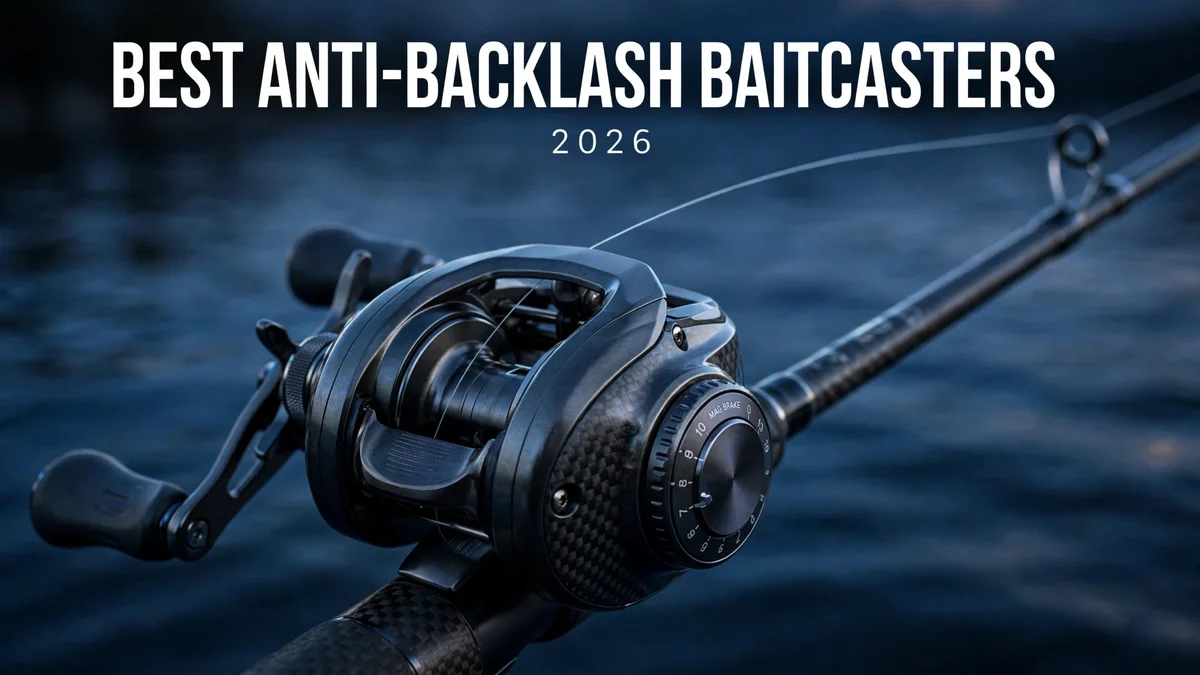
Short answer: The best anti-backlash baitcaster for most anglers is the Shimano Curado DC, its I-DC4 braking monitors spool speed 1,000 times per second and prevents overruns on its own. The Shimano SLX DC is the budget pick, the Daiwa Tatula SV TW excels in wind, and the Lew’s Tournament Pro LFS and Abu Garcia Revo SX offer mechanical braking you can tune. No reel eliminates backlash entirely.
As an Amazon Associate we earn from qualifying purchases.
Finding the best anti backlash baitcaster is really about finding the reel whose braking system forgives the most mistakes. A backlash, the dreaded bird’s nest, happens when the spool spins faster than the lure pulls line off it, and it ruins more mornings on the water than any other beginner problem. Modern brake technology has made overruns far less punishing than a decade ago: digital control (DC) reels read spool speed thousands of times per second and adjust braking on the fly, while SV-style spools and dual-brake systems keep the spool under control mechanically through the whole cast. For a head-to-head of the two main brake types, see our brake systems compared.
We evaluated this category with a technique-led, on-water approach: casting each reel with lures from 1/4 oz finesse jigs to 3/4 oz spinnerbaits, in calm air and headwinds, on 12 lb mono and 30 lb braid, scoring how each system behaved at the three moments backlashes start; launch, mid-flight, and splashdown. The five reels below stood out for genuinely different reasons: digital automation, spool physics, tunable dual brakes, and brute-force cast control.
Why Trust BaitcastingReelz
- Hands-on specs verification: every spec, gear ratio, and line capacity is checked against current manufacturer listings before it goes on the page.
- No sponsored rankings: brands cannot pay for placement. Our picks are technique-led, and our affiliate disclosure is on every money page.
- Updated monthly: prices, model generations, and availability are re-checked regularly, so you never order a discontinued reel.
Quick Picks: Our Top 5 Anti-Backlash Baitcasters
- Best Overall: Shimano Curado DC 151, I-DC4 digital braking that practically thinks for you
- Best DC Value: Shimano SLX DC 151HG, automated backlash control for around $200
- Best SV Spool Control: Daiwa Tatula SV TW 103, calm casts in wind with lighter lures
- Best Adjustable Braking: Abu Garcia Revo SX, externally adjustable IVCB-6 with 25 lb drag
- Best Dual-Brake All-Rounder: Lew’s Tournament Pro LFS, magnetic + centrifugal MSB system
Comparison Table
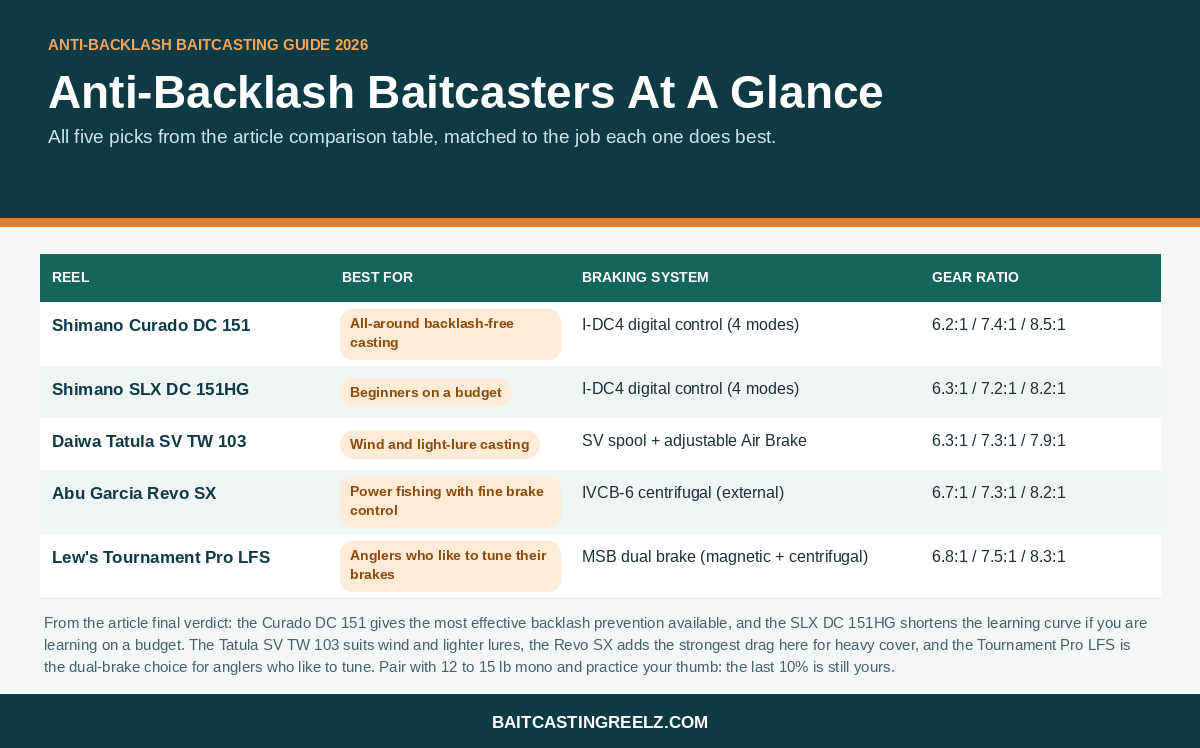
| Reel | Best for | Braking system | Gear ratio | Approx. price |
|---|---|---|---|---|
| Shimano Curado DC 151 | All-around backlash-free casting | I-DC4 digital control (4 modes) | 6.2:1 / 7.4:1 / 8.5:1 | ~$280 |
| Shimano SLX DC 151HG | Beginners on a budget | I-DC4 digital control (4 modes) | 6.3:1 / 7.2:1 / 8.2:1 | ~$200 |
| Daiwa Tatula SV TW 103 | Wind and light-lure casting | SV spool + adjustable Air Brake | 6.3:1 / 7.3:1 / 7.9:1 | ~$200 |
| Abu Garcia Revo SX | Power fishing with fine brake control | IVCB-6 centrifugal (external) | 6.7:1 / 7.3:1 / 8.2:1 | ~$190 |
| Lew’s Tournament Pro LFS | Anglers who like to tune their brakes | MSB dual brake (magnetic + centrifugal) | 6.8:1 / 7.5:1 / 8.3:1 | ~$200 |
How We Evaluate Anti-Backlash Baitcasters
Backlash resistance is not a lab measurement, it is a behavior under changing conditions, so it was evaluated the way an angler experiences it. Each reel was cast across lure weights from 1/4 oz to 3/4 oz, in calm conditions and in a steady headwind, on 12 lb mono and then 30 lb braid. We scored four things: launch control, mid-flight stability, splashdown recovery, and ease of setup for a beginner. Frame rigidity, gear material, and bearing protection were weighed too, because a backlash-resistant reel you must replace in two seasons is a poor recommendation.
The 5 Best Anti-Backlash Baitcasters for 2026
1. Best Overall: Shimano Curado DC 151
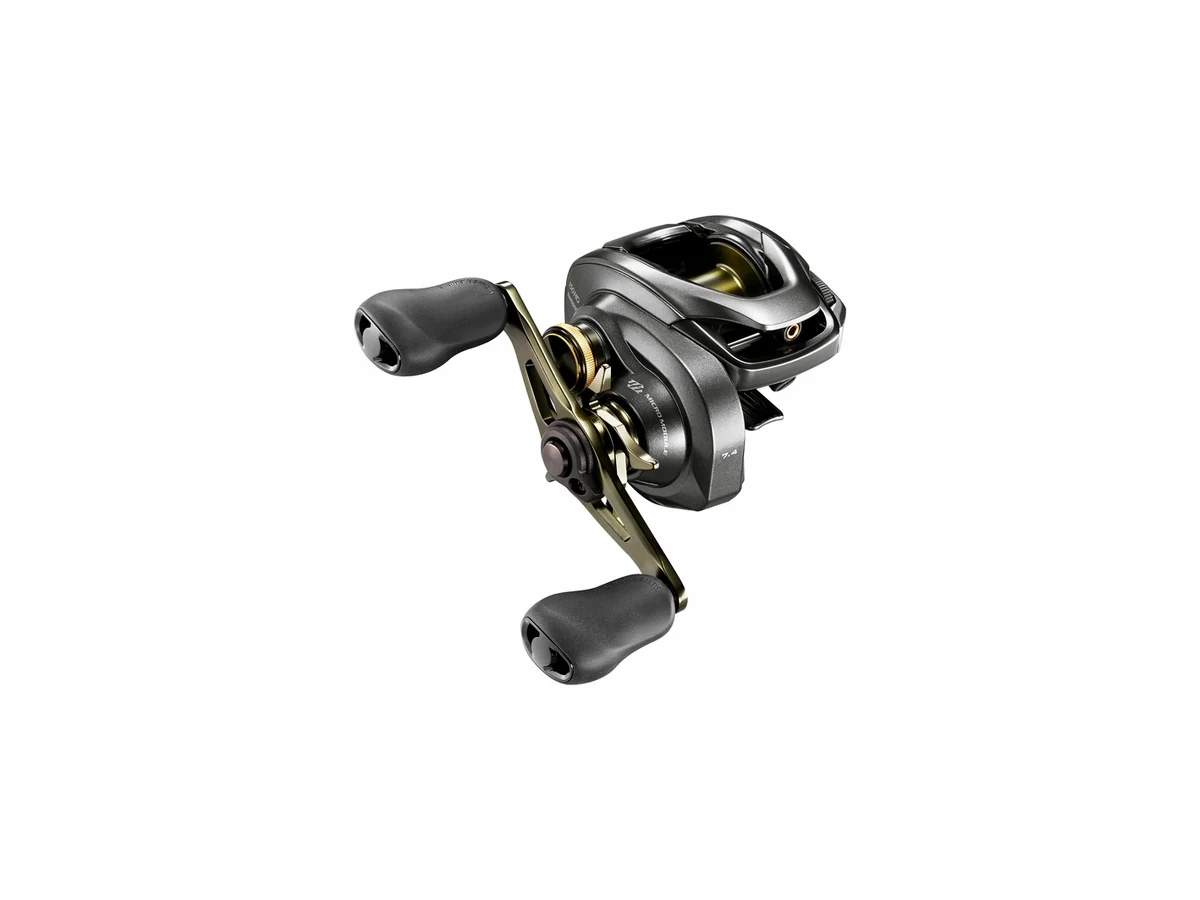
The Curado DC is the reel that made digital braking the default answer to backlash. Its I-DC4 system; powered by the cast itself, with no batteries; monitors spool speed 1,000 times per second and applies braking force exactly when overruns start: at launch, mid-flight, and splashdown. The external dial offers four modes (max distance, braid/mono, fluorocarbon, max brake), and most anglers can leave it on the general setting while swapping from a 3/8 oz jig to a 1/2 oz spinnerbait without re-tuning.
Best for: All-around bass anglers who want the closest thing to set-and-forget casting, from beginners skipping docks to experienced anglers throwing into headwinds.
Why it wins: The DC system adapts to gusts, wind-catching lures, and sudden skips, conditions no fixed brake anticipates. Built on the proven Curado platform with a HAGANE body, MicroModule gearing, and Cross Carbon Drag, it gives back the ten minutes per trip most anglers spend picking out bird’s nests.
Pros
- Near-automatic backlash prevention across lure weights and wind conditions
- Four external brake modes, no side plate removal to adjust
- HAGANE aluminum body with virtually no flex under heavy load
- Smooth MicroModule gears and 11 lb Cross Carbon Drag
- Available in left and right retrieve, 6.2:1, 7.4:1, and 8.5:1 ratios
Cons
- Noticeable price premium over the non-DC Curado K
- Faint electronic hum on the cast, most anglers tune it out, some don’t
- At 7.8 oz it’s heavier than several competitors here
Best for: Best overall, anglers who want digital braking to handle backlash for them
Why choose it: The I-DC4 system monitors spool speed 1,000 times per second and applies braking force exactly when needed, no batteries, powered by the cast itself
Specs: 7.4:1 gear ratio (151HG) · 7.8 oz · 6+1 bearings · 11 lb max drag · 12/110 mono capacity
2. Best DC Value: Shimano SLX DC 151HG
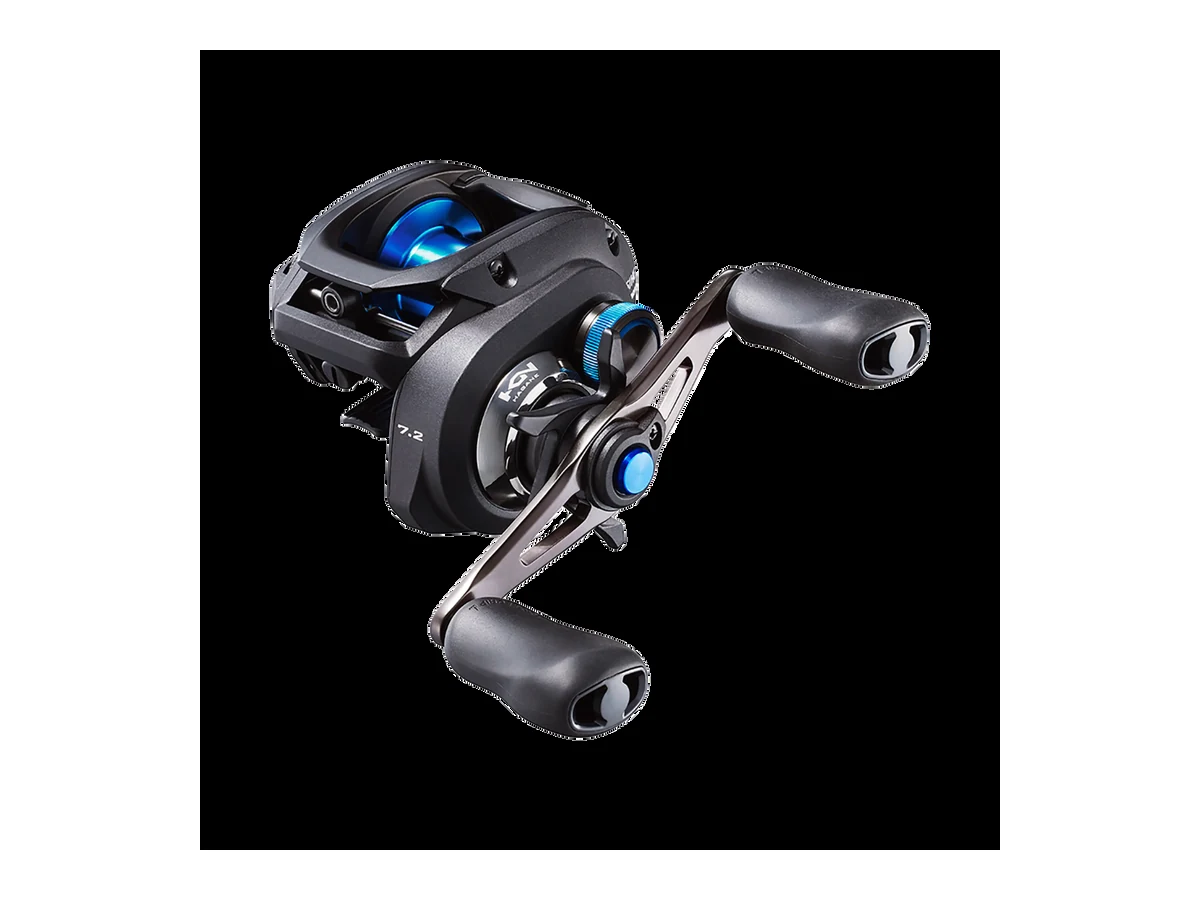
The SLX DC puts the same I-DC4 digital braking found in the Curado DC into a reel priced around $200, the strongest value proposition in this roundup. For a beginner, the microcomputer-managed spool is far more forgiving of a mistimed cast than any magnetic dial, and the four external modes are simple enough to grasp on the first outing. Set the spool tension once, pick max-brake mode, and you can learn thumb control at your own pace instead of under pressure. It stays noticeably calmer than conventional reels at this price when a headwind arrives or lure weight changes between casts, the two situations that create most beginner bird’s nests.
Best for: Beginners moving from spinning gear, and any angler who wants digital backlash protection without paying flagship prices.
Why it wins: No other reel near this price automates spool management the way DC does: the single most effective anti-backlash technology, in a HAGANE-bodied reel, for the cost of a good conventional mid-range baitcaster.
Pros
- Genuine I-DC4 digital braking at a ~$200 price point
- Extremely forgiving for beginners, minimal thumbing required
- HAGANE metal body keeps gearing aligned under load
- Four simple external brake modes for different lines and conditions
- Light enough (7.9 oz) for all-day casting
Cons
- Only 4+1 bearings, fewer than most rivals here
- Graphite side plates rather than full metal construction
- DC helps enormously but cannot prevent every backlash, especially in braid
Best for: Best DC value, beginners who want Curado DC braking around $200
Why choose it: The same I-DC4 digital braking as the Curado DC at around $200, far more forgiving of a mistimed cast than a mechanical brake
Specs: 7.2:1 gear ratio (151HG) · 7.9 oz · 4+1 bearings · 11 lb max drag · 12/110 mono capacity
3. Best SV Spool Control: Daiwa Tatula SV TW 103
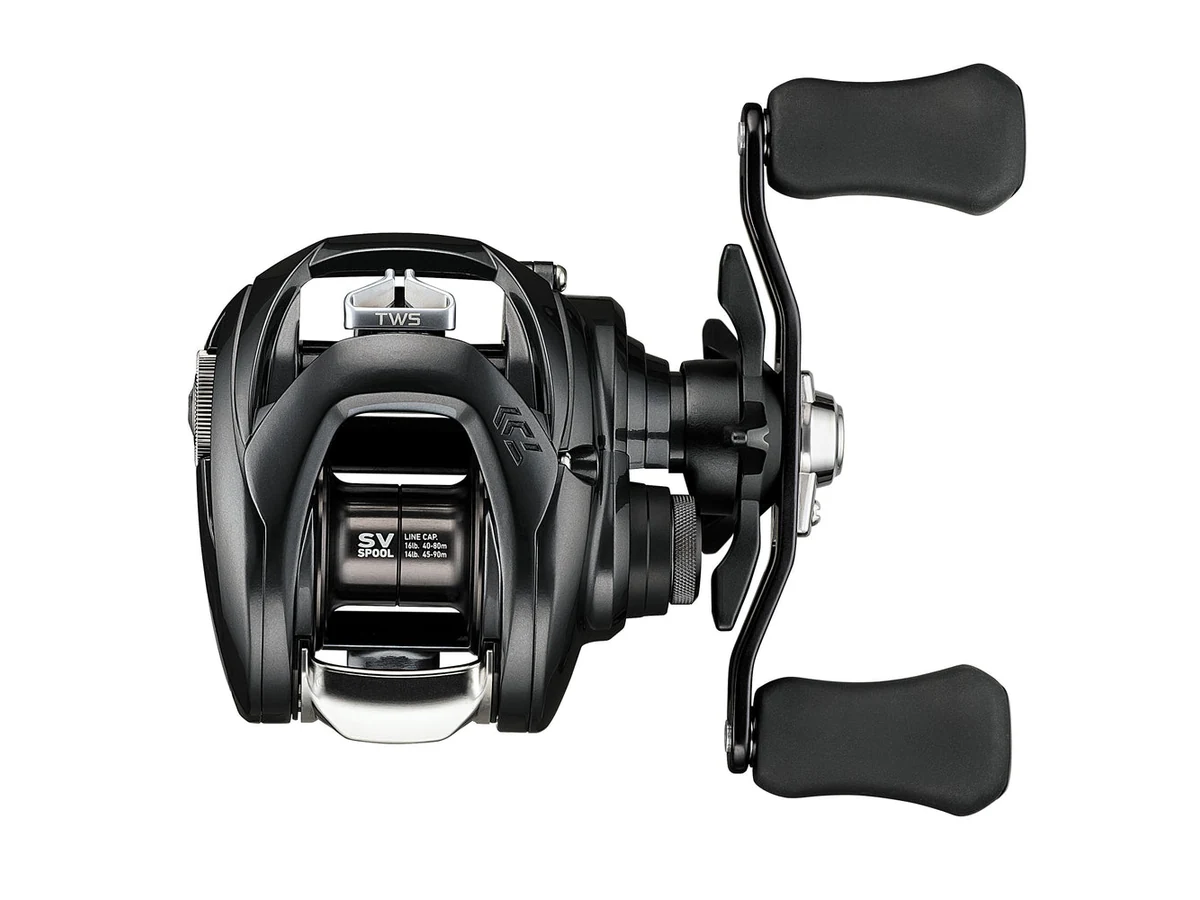
The Tatula SV TW fights backlash with physics instead of electronics. Daiwa’s SV (Stress-Free Versatile) spool is light and wide-arbor, so it carries less inertia and is inherently less eager to overrun; the externally adjustable Air Brake dial and T-Wing line guide, which lets line exit with minimal angle and friction, complete the package. The result is a remarkably calm mid-cast feel: where a conventional spool surges ahead of a decelerating lure, the SV spool slows with it. That shines with lighter baits (down to about 1/4 oz) and in wind, and at 6.7 oz it is the lightest reel in this roundup.
Best for: Anglers who fish windy water or throw light-to-medium lures and want backlash resistance without digital electronics.
Why it wins: The SV spool excels precisely where DC is least magical, light lures in gusty conditions, and it casts small baits that heavier-spooled reels cannot control. For finesse-adjacent bass fishing, it is the most controlled-feeling reel at this price.
Pros
- SV spool resists overrun mechanically, excellent with light lures and wind
- Externally adjustable Air Brake dial, no tools or side-plate removal
- T-Wing guide reduces line friction for longer, smoother casts
- Lightest reel here at 6.7 oz, comfortable all-day palming
- 13.2 lb max drag with Daiwa’s Ultimate Tournament Drag
Cons
- SV spool trades away a little top-end casting distance vs. deeper spools
- Less “automatic” than DC, the dial still needs to match lure weight
- Newer Tatula SV models exist, so shop carefully for this generation’s price
Best for: Best SV spool control, anglers who prefer physics over electronics
Why choose it: The light, wide-arbor SV spool carries less inertia and is inherently less eager to overrun, with externally adjustable Magforce braking
Specs: 7.3:1 gear ratio (103HS) · 6.7 oz · 7+1 bearings · 13.2 lb max drag · 14/100 mono capacity
4. Best Adjustable Braking: Abu Garcia Revo SX
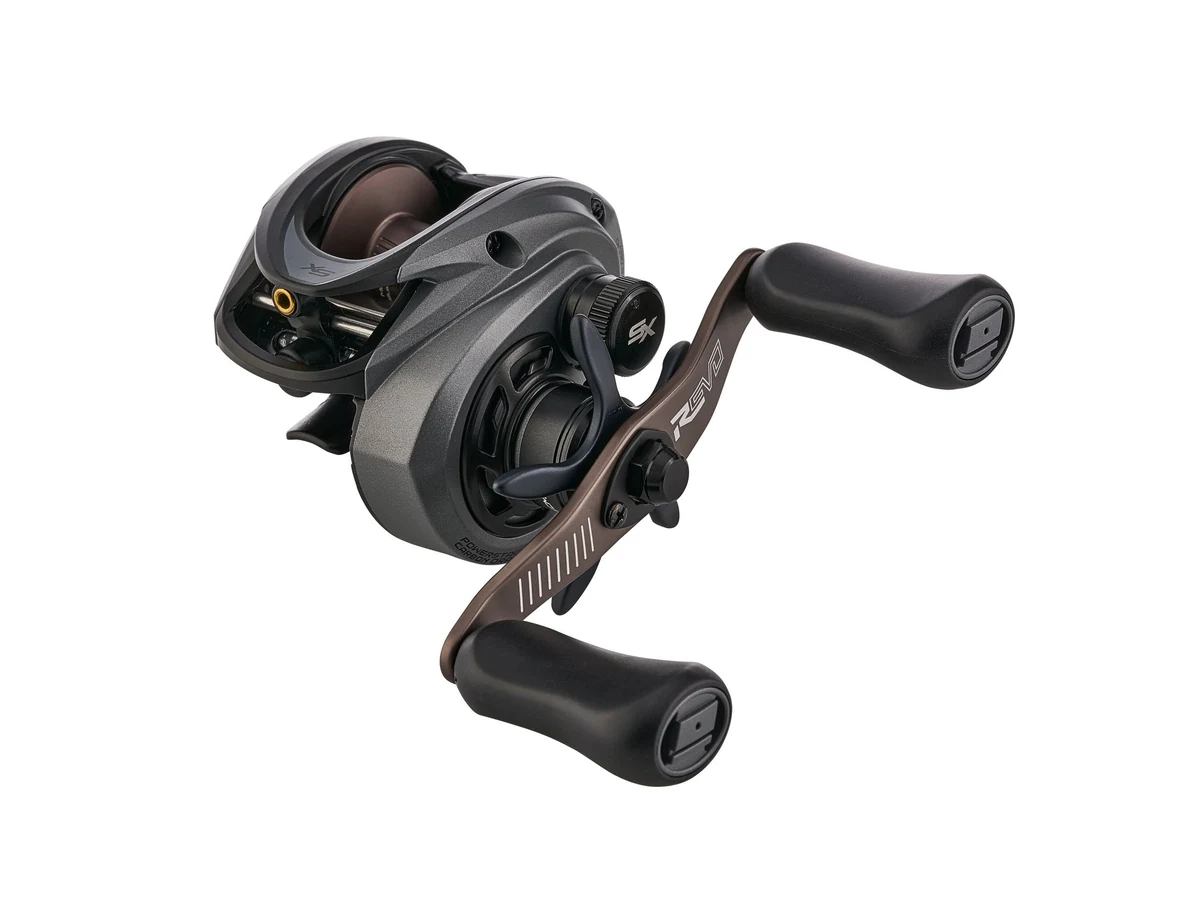
The Revo SX is the workhorse of the $150–$200 class, and its IVCB-6 braking system earns it a place here: six externally adjustable centrifugal brake blocks tunable with near-limitless granularity, without opening the reel. When the wind picks up or you tie on a heavier jig, the brake can be bumped between casts rather than at the workbench. Around that brake sits a serious power package; an X2-Cräftic alloy frame, D2 gear design with brass main gear, and a Power Stack Carbon Matrix drag rated to 25 lbs, the strongest in this roundup.
Best for: Power anglers who want fine-grained, externally adjustable braking plus heavy drag for pulling bass out of thick cover.
Why it wins: Most anti-backlash reels compromise on fish-fighting power; the Revo SX refuses to. IVCB-6 gives beginners a wide, forgiving adjustment range while the alloy frame, brass gears, and 25 lb drag handle flipping, frogging, and heavy cover; backlash control and big-fish muscle in one body.
Pros
- IVCB-6 brakes adjust externally with excellent fine-tuning range
- 25 lb Power Stack drag, strongest in this roundup by a wide margin
- X2-Cräftic alloy frame and brass main gear for durability
- 9+1 stainless steel bearings for smooth retrieve
- Multiple ratios (6.7:1, 7.3:1, 8.2:1) and left/right retrieve
Cons
- Current generation dropped the older dual magnetic/centrifugal system for centrifugal-only
- At ~7.5 oz it’s on the heavier side for all-day finesse work
- Base 6.7:1 ratio is a touch slow for burning frogs or buzzbaits, check the 8.2:1 variant
Best for: Best adjustable braking, tuners who want fine control without opening the reel
Why choose it: IVCB-6 gives six externally adjustable centrifugal brake blocks with near-limitless granularity
Specs: 7.3:1 gear ratio · ~7.5 oz · 9+1 bearings · 25 lb max drag · 130/12 mono capacity
5. Best Dual-Brake All-Rounder: Lew’s Tournament Pro LFS
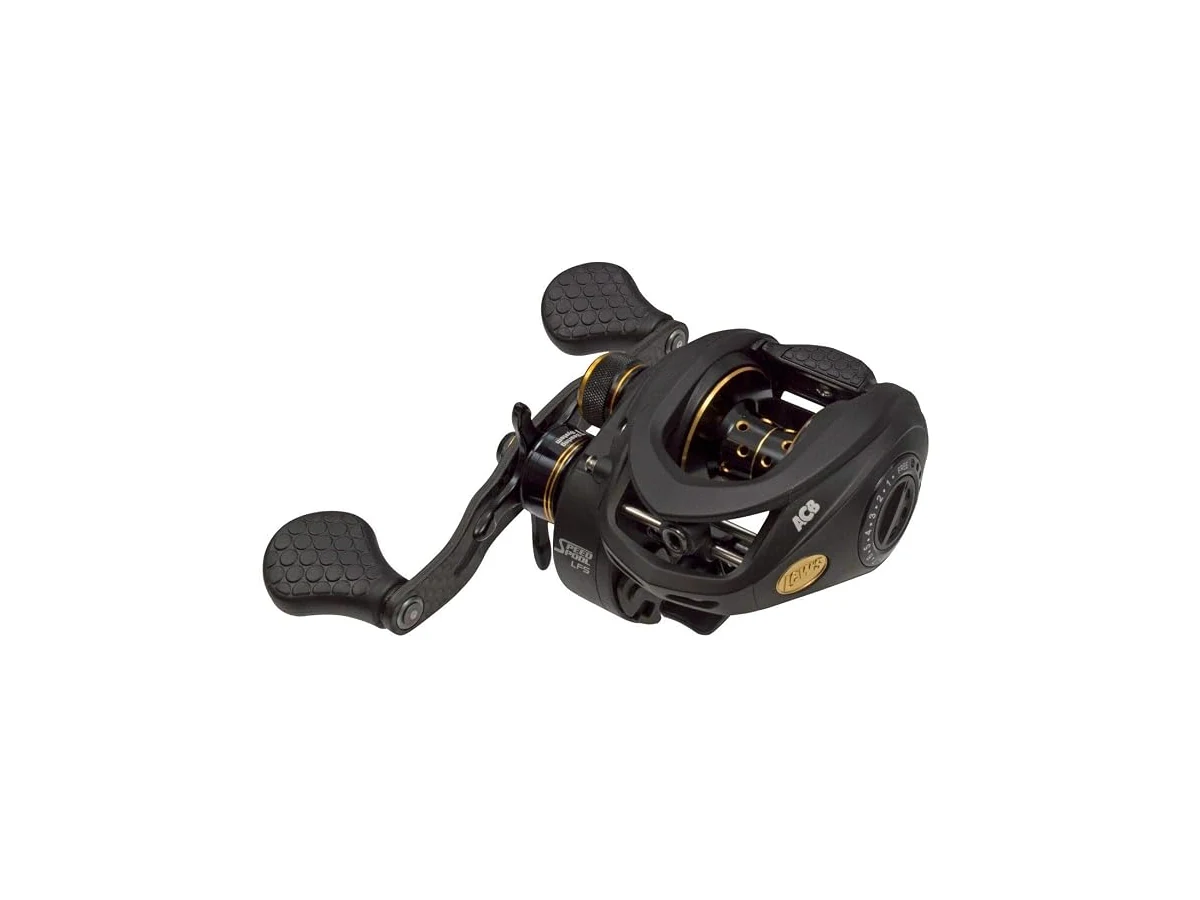
The Tournament Pro LFS is the pick for anglers who enjoy tuning, thanks to the MSB (Multi-Setting Brake) dual-brake system: an external magnetic click-dial plus four internally adjustable centrifugal brake shoes. The two layers work independently, centrifugal blocks manage the violent launch, while the magnetic dial trims mid-flight and splashdown. Set two or three shoes on and the dial near mid-range, and it stays forgiving across 1/4 to 3/4 oz lures; dial down and it opens into a long-distance caster. At 6.4 oz with a one-piece aluminum frame and 20 lb carbon drag, it punches above its ~$200 price.
Best for: Bank anglers and tinkerers who fish changing conditions and want dual-brake adjustability without digital pricing.
Why it wins: Dual braking is the most versatile mechanical answer to backlash, centrifugal for launch, magnetic for everything after. For the angler who fishes spinnerbaits, jigs, and crankbaits on one reel in a single day, that adjustability is worth more than automation.
Pros
- True dual braking: magnetic dial + centrifugal shoes work independently
- Very light at 6.4 oz with a rigid one-piece aluminum frame
- Wide tuning range, forgiving for beginners, fast for experienced casters
- 20 lb carbon fiber drag and zirconia line guide
- Available in 6.8:1, 7.5:1, and 8.3:1 ratios, left and right retrieve
Cons
- Dual-brake tuning has a learning curve, less automatic than DC
- Lew’s has refreshed this line (Gen 2 “G” models), so confirm which brake system you’re buying
- Smaller dealer and service network than Shimano or Daiwa
Best for: Best dual-brake all-rounder, anglers who enjoy tuning both brake systems
Why choose it: The MSB dual-brake pairs an external magnetic click-dial with four internally adjustable centrifugal shoes, two layers of control
Specs: 7.5:1 gear ratio (TP1SHA) · 6.4 oz · 10+1 bearings · 20 lb max drag · 120/12 mono capacity
Anti-Backlash Baitcasters: Honest Pros and Cons
Before the reviews, a straight assessment of the category, because anti-backlash technology solves a lot, but not everything.
Pros
- Fewer ruined casts. DC chips and SV spools cut overruns dramatically in wind, on skips, and when switching lure weights, the exact moments backlashes strike.
- Faster learning curve. Beginners spend more time fishing and less time picking out bird’s nests, which is why several of these picks double as beginner reels.
- Longer effective range. With the spool managed for you, more anglers can fish lighter lures and longer casts than their thumb alone would allow.
Cons
- They cost more. DC and SV technology adds a real premium over the same reel’s standard-brake sibling, experienced casters may not feel the difference.
- No reel replaces technique. Spool tension setup, line choice, and thumb control still matter; an anti-backlash reel with bad setup will still backlash.
- Finesse has limits. Very light lures (under ~1/8 oz) remain spinning-reel territory for most anglers, DC chip or not.
Why Backlash Actually Happens: The Two-Phase Problem
Every bird’s nest is the same physics failure: the spool is spinning faster than line is leaving it. Understanding the two moments this happens is what separates anglers who fight backlash forever from those who fix it in an afternoon.
Phase one: the launch. When you whip a rod forward, the lure yanks line off the spool, but the light, free-spinning spool overshoots: by the time the lure reaches cruising speed, the spool is already spinning faster than necessary. Centrifugal brakes are built for this moment, their blocks fling outward hardest at high spool RPM, so they bite hardest at launch and fade as the cast settles.
Phase two: deceleration. Mid-flight, air resistance slows the lure, and at splashdown it stops almost instantly, but the spool keeps spinning and pays out loose loops that tangle. This phase causes most beginner backlashes. Magnetic brakes shine here (constant force regardless of spool speed), low-inertia SV spools carry less momentum into the stall, and DC systems read the slowdown and clamp the spool in real time. If one still gets past you, our guide to removing a backlash covers the fix.
Braking Systems Compared: DC vs Magnetic vs Centrifugal vs Dual
The four braking families work on different principles, and each has a backlash-prevention personality. This is the comparison most roundups skip, and it determines which reel above fits you.
| Brake type | How it works | Strengths | Weaknesses | Best for |
|---|---|---|---|---|
| Digital / DC (Curado DC, SLX DC) | Microcomputer varies braking 1,000×/second | Adapts to gusts and lure changes; nearly set-and-forget | Price premium; faint electronic hum | Beginners and anyone who hates tuning |
| Magnetic (Lew’s MCS, many budget reels) | Magnets create constant resistance; external dial | Easy adjustment; constant through the cast; great at splashdown | Same force at launch as at the end, can rob distance | Wind and steady all-day casting |
| Centrifugal (Revo SX IVCB-6) | Brake blocks fling outward at high spool speed | Strongest at launch, fades for distance | Weakest at splashdown; internal versions need side-plate removal | Hard casters and distance work |
| Dual (Lew’s MSB) | Centrifugal blocks + magnetic dial, independent | Launch and mid-cast tuned separately, widest range | Two systems to learn | Anglers fishing many lure weights in one day |
| SV spool + brake (Tatula SV TW) | Light, wide spool carries less momentum + brake dial | Inherently calm; superb with light lures and wind | Slightly less max distance than deep spools | Finesse-to-midweight bass fishing |
For the full picture on matching any reel to your fishing, read our guide on how to choose the best baitcasting reel, braking is only one of the criteria that matter. And if you are just starting out, our our beginner baitcaster roundup roundup ranks these same systems specifically for learning.
Which Anti-Backlash Reel for Which Fishing
The five reels above solve the same problem in different ways, so the right pick depends on how you fish, not on which brake sounds most impressive. Match the reel to your most common situation and the choice gets simple. If you are still learning the setup behind these systems, our guide on adjusting your reel walks through spool tension, brakes, and drag in order.
| Reel | Best for | Why it fits |
|---|---|---|
| Shimano Curado DC 151 | All-around bass fishing, docks, wind, and lure changes | I-DC4 adapts through the cast, the closest to set-and-forget |
| Shimano SLX DC 151HG | Beginners learning on a budget | Same I-DC4 braking near $200, the most forgiving first reel |
| Daiwa Tatula SV TW 103 | Windy water and light lures | SV spool carries less momentum, calm with 1/4 oz baits |
| Abu Garcia Revo SX | Heavy cover and power fishing | IVCB-6 fine tuning plus 25 lb drag, the strongest here |
| Lew’s Tournament Pro LFS | Anglers who fish many lure weights in one day | Dual brakes tune launch and mid-cast separately |
How to Set Your Brakes to Avoid Backlash (Beginner Walkthrough)
Even the best anti-backlash baitcaster needs a correct setup, this five-minute process is what beginners most often skip, and it causes more bird’s nests than any reel choice. (For the full tuning process, see our adjustment guide.)
- Tie on the lure you will actually fish. Brake settings are lure-specific; a 1/2 oz jig and a 1/4 oz crankbait need different settings.
- Do the drop test. Hold the rod tip up at 45 degrees, press the thumb bar, and tighten the spool tension knob until the lure falls slowly and the spool stops the instant the lure hits the ground.
- Set brakes conservatively to start. DC reels: Mode 2 (braid/mono) or Mode 4 (max brake) while learning. Lew’s dual brake: 3 of 4 centrifugal shoes on, magnetic dial at 6–7. Revo SX: 4 of 6 IVCB blocks on. Tatula SV: Air Brake dial at ~70%.
- Make short, smooth practice casts, 30 feet, not 60. Smooth acceleration creates fewer launch overruns than a violent whip.
- Loosen gradually. Once ten casts go clean, back the brakes off one click at a time until distance improves without overruns.
- Re-check when conditions change. A headwind at midday means adding 2–3 clicks of brake or one DC mode up, this single habit prevents most mid-trip backlashes.
Line Choice: the Easiest Way to Reduce Backlash
Line affects backlash frequency as much as the reel does. Start with 12–15 lb monofilament, thicker, slightly stretchy, and the easiest to pick out of a backlash. Fluorocarbon is denser and springier, so add one or two clicks of brake, especially in light tests. Braid is the least forgiving line to learn on: it digs into itself and a braid backlash can weld into an unfixable knot, use 30–40 lb test with extra brake. Whatever you choose, spool it correctly with proper tension: loosely wound line digs in on the hookset and guarantees the next cast will overrun.
Thumbing Technique: the Skill No Reel Replaces
Here is the honest part every anti-backlash article should include: no reel eliminates backlash entirely, and your thumb is still the final brake. DC systems and SV spools shrink the problem dramatically, but a mistimed cast into a gust, or a lure clipping a branch mid-flight, will still overrun any spool. Keep your thumb hovering just above the spool through the cast, feather it down lightly as the lure nears the water, and clamp the moment it touches down. Ten minutes of practice on grass with a 1/2 oz plug teaches the timing. For more fundamentals, see our our beginner guide. Another anti-backlash option worth comparing is covered in our Abu Garcia Revo Rocket review.
Frequently Asked Questions
Is there a baitcaster that won’t backlash?
No reel is 100% backlash-proof, any spool can overrun if the lure stops suddenly mid-cast. But DC reels like the Shimano Curado DC and SLX DC, SV-spool reels like the Daiwa Tatula SV TW, and well-tuned dual-brake reels make backlashes rare rather than routine. Think of anti-backlash technology as a very good assistant, not a replacement for basic setup and thumb control.
Do anti-backlash reels really work, or is it just marketing?
The technologies are real: DC systems genuinely modulate braking through the cast, SV spools genuinely carry less overrun momentum, and dual brakes genuinely cover both phases of a backlash. What marketing oversells is zero maintenance, every one of these reels still needs the drop test, sane brake settings, and a thumb at splashdown. Set up correctly, anglers go from several backlashes per trip to nearly none.
What is the best line to avoid backlash on a baitcaster?
Twelve to fifteen pound monofilament is the best line to learn on: forgiving, resistant to digging into the spool, and the easiest to pick out of a backlash. Fluorocarbon works well once you add a click or two of brake for its stiffness. Save braid until your thumb is trained, then use 30–40 lb test with extra brake.
Magnetic vs centrifugal brakes: which is better for beginners?
Magnetic brakes are easier for beginners: a simple external dial, constant force through the whole cast, including splashdown, where most beginner backlashes happen. Centrifugal brakes are stronger at launch but fade late. A dual-brake or DC reel gives you both behaviors without choosing.
Why does my baitcaster still backlash with the brakes turned up?
Three usual causes: the spool tension knob is too loose (do the drop test first, brakes can’t fix a free-spinning spool), loosely spooled line that digs in, or an overly violent cast. And thumb the spool at splashdown, that habit fixes more backlashes than any brake setting.
Do DC reels need batteries?
No. Shimano’s I-DC4 system is powered by the cast itself, the spinning spool generates the electricity the microcomputer needs. There is nothing to charge, replace, or maintain. The system is also sealed against water, though like any reel it should be rinsed and dried after saltwater use.
Which anti-backlash baitcaster is best for a beginner?
The Shimano SLX DC 151HG. It carries the same I-DC4 digital braking as the Curado DC at around $200, so it forgives mistimed casts and changing lure weights while you learn thumb control. Start in max-brake mode, do the drop test, and loosen the brakes one click at a time as your casting gets consistent.
Do I still need to thumb the spool with an anti-backlash reel?
Yes. No reel eliminates backlash entirely, and your thumb is still the final brake. Keep it hovering just above the spool through the cast, feather it down as the lure nears the water, and clamp the moment the lure touches down. Ten minutes of practice on grass with a 1/2 oz plug teaches the timing.
Final Verdict: Which Anti-Backlash Baitcaster Should You Buy?
Get the Shimano Curado DC 151 if you want the most effective backlash prevention available and fish a bit of everything. Get the Shimano SLX DC 151HG if you’re learning on a budget, DC shortens the learning curve more than any $200 conventional reel. Get the Daiwa Tatula SV TW 103 if you fish wind or throw lighter lures and prefer mechanical simplicity. Get the Abu Garcia Revo SX for backlash control plus the strongest drag here for heavy cover. Get the Lew’s Tournament Pro LFS if you enjoy tuning and want dual-brake versatility. Whichever you choose, pair it with 12–15 lb mono, do the drop test, and practice your thumb; the reel handles the physics, but the last 10% is still yours. Every reel on this list also appears in our broader guide to the our main baitcaster roundup, ranked by technique and budget.
Updated 16 October 2026.