Beginner hub · 2026
11 Beginner Baitcaster Mistakes (and How to Fix Each One)
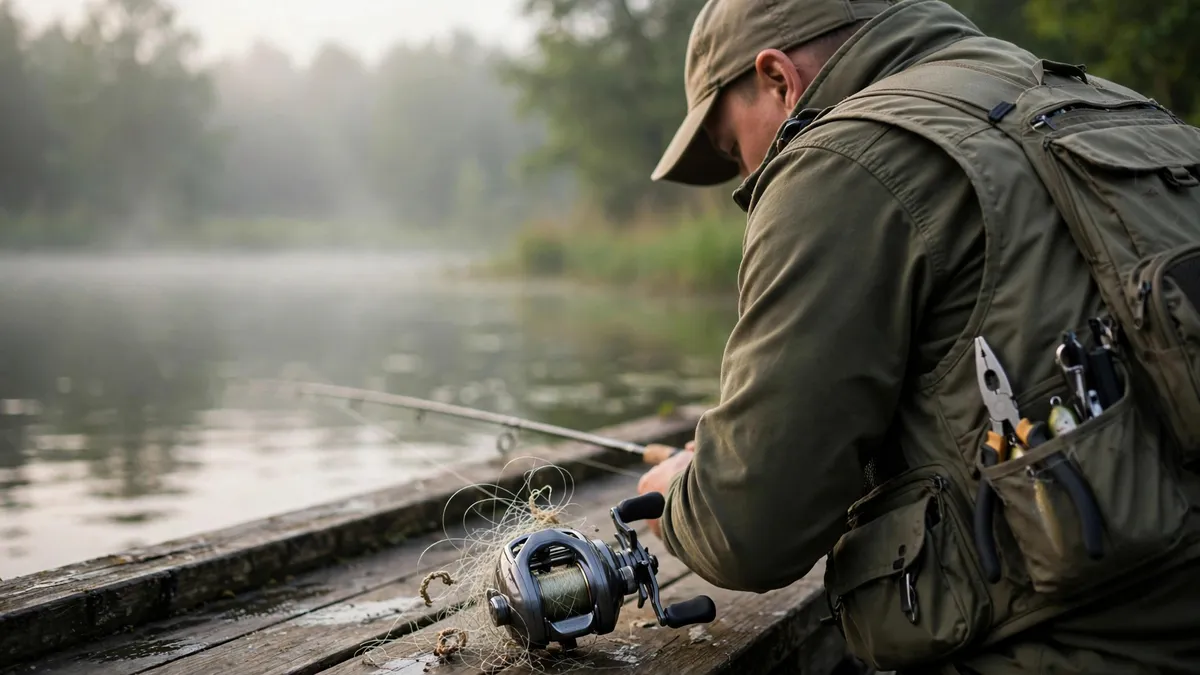
If your baitcaster keeps turning your fishing trip into a knot-picking session, you are not cursed. You are just making one or more of the same 11 mistakes almost every beginner makes. Below I rank them by what each one costs you in lost fishing time and line, and I give you a concrete fix for each. Most fixes take under two minutes, and the first three mistakes account for most of the bird’s nests beginners ever see.
Affiliate disclosure: As an Amazon Associate, baitcastingreelz.com earns from qualifying purchases at no extra cost to you.
Every beginner backlash comes from the same physics: the spool is spinning faster than the lure is pulling line off it. The 11 mistakes below are the 11 ways beginners create that mismatch, pulled from forum threads and retailer Q and A pages, ranked by damage.
Starting from zero? Pair this page with how to cast a baitcaster for the motion, the beginner guide for the habits, and our backlash removal guide if you already have a nest.
Mistake 1 of 11 · Setup
1. Never setting the spool tension knob (or confusing it with the star drag)
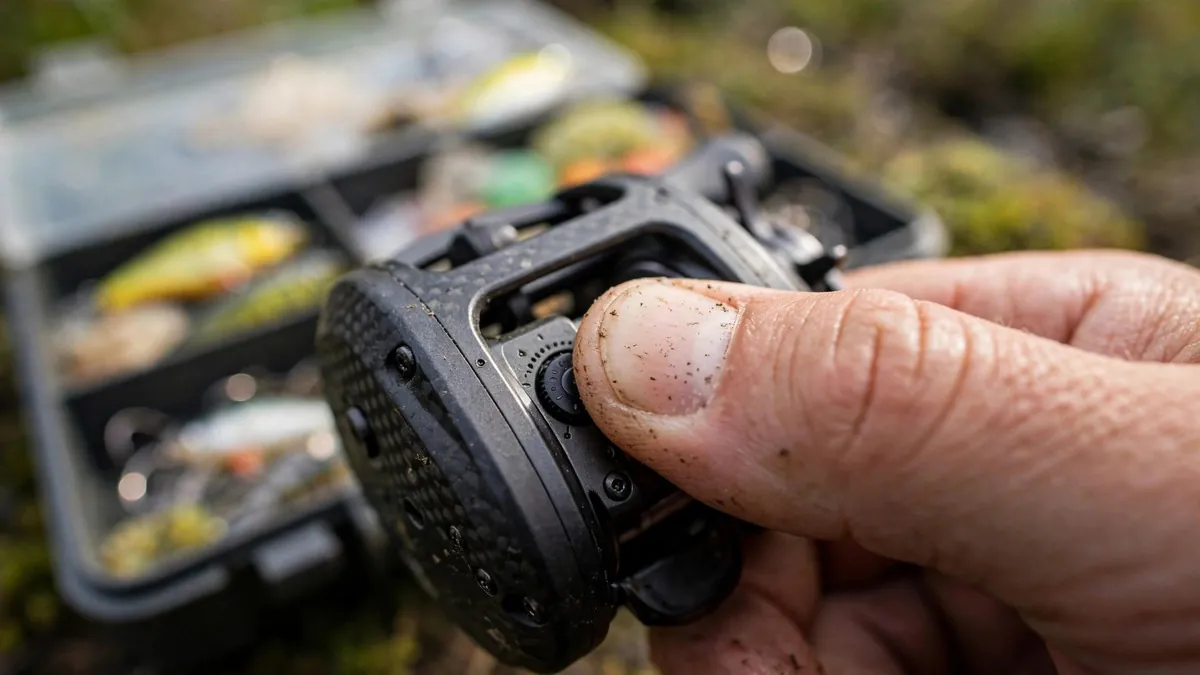
This ruins more trips than anything else. The spool tension knob controls how freely the spool spins at the start of a cast; the star drag controls resistance during a fish’s run and has nothing to do with casting. Beginners either ignore the knob or tighten the drag, thinking it stops backlashes. The BassFishin.Com forum consensus: almost every chronic-backlash thread ends with someone explaining this difference.
Tie on your lure, hold the rod at 45 degrees, press the thumb bar, and back the tension off until the lure falls slowly and the spool stops when it hits the ground. That is the drop test; redo it every lure change. Full order in my how to prevent backlash on a baitcaster guide.
Mistake 2 of 11 · Brakes
2. Starting with the brakes wide open
New reels often arrive with the magnetic dial at zero, and beginners cast them as they came out of the box: a bird’s nest on the first real cast. Beyond Braid’s Q and A repeats the same correction: start near the top of the braking range.
Set a magnetic or dual-brake reel to about 70 percent of maximum. Casts will be shorter; that is the cheap price of learning. Back the brakes down one click at a time after consecutive clean casts. Backlashes in the first third of the cast mean brakes are too low; at the very end they mean thumb timing, which is mistake five. For the full setup order in one place, see how to set up your brakes and spool tension.
Mistake 3 of 11 · Technique
3. Muscling every cast like a baseball throw
The harder you throw, the harder the spool spins, and a beginner’s extra force is never matched by extra thumb control. FishingToolReviewer and casting coaches agree: baitcasters reward a smooth, wrist-led motion, not arm strength. The rod does the work; your arm aims.
Practice overhead casts at 50 percent effort: flick a paper airplane, do not hurl a fastball. Distance comes from clean energy transfer, not force. Full motion in my how to cast a baitcaster guide.
Mistake 4 of 11 · Lure selection
4. Throwing a lure too light for the setup
A baitcaster needs the lure’s weight to pull line off the spool at a steady rate. A lure that is too light stalls mid-flight while the spool keeps spinning: an instant overrun. Every rod prints a lure weight range on the blank for a reason. Ignore it and the physics punish you.
Start with lures of a quarter ounce to half an ounce, inside the printed range on your rod. Very light lures need a BFS (bait finesse) setup, not a standard reel with tweaked settings. My my bass setup guide guide covers matching lure weight and rod rating.
Mistake 5 of 11 · Thumb control
5. Forgetting the thumb, especially at the end of the cast
Brakes control the spool at launch, but only your thumb controls it at landing, when the lure slows or hits the water and the spool keeps spinning. The most repeated advice across forums and tutorials, from Realtree to BassFishin.Com threads: keep your thumb close to the spool and stop it dead before the lure lands.
Keep light thumb contact through the flight and press down firmly before the lure reaches its target, not after. Stopping early costs a few yards; stopping late costs a bird’s nest. My how to prevent backlash on a baitcaster guide has a full section on this timing.
Mistake 6 of 11 · Conditions
6. Casting into the wind like it is a calm day
A headwind slows the lure mid-flight while the spool keeps spinning at full speed. Even experts backlash into wind; it is the top cause of a sudden nest on a clean setup. Wind is the great equalizer: pros add brake or switch to spinning gear when it gets bad.
Into wind: add braking first, tighten tension slightly, cast lower, and shorten your distance. Sidearm casts stay out of the gusty air better than overhead. Wind protocol in our bass setup guide.
Mistake 7 of 11 · Spooling
7. Overfilling the spool
Fill the spool to the lip and the top wraps have nothing containing them: line balloons off, loops form, and you get tangles that look like backlashes but come from line management instead of settings. The consensus fill is about 1/8 inch below the spool lip, no more.
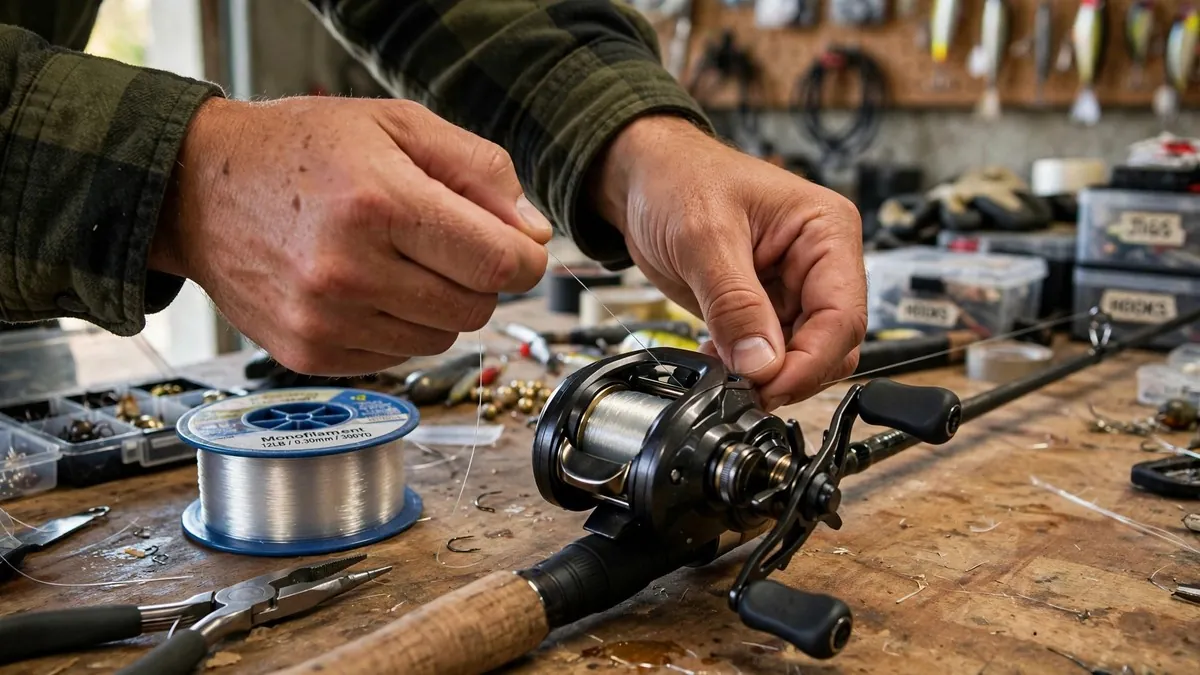
Spool with steady tension to that gap, winding the line on in the same direction the reel takes it up. Loose wraps will haunt you for weeks and no brake setting can fix them. Strip and respool if the existing line was wound loosely.
Mistake 8 of 11 · Line choice
8. Learning on braid or fluorocarbon instead of mono
Line type changes how badly a backlash punishes you. Braid has zero stretch, so when it overruns it digs into itself and welds into a knot that is miserable to pick out. Fluorocarbon is stiff and kinks, and a kink is a weak spot. Monofilament is cheap, has some stretch, and is the easiest line to pick out of a nest.
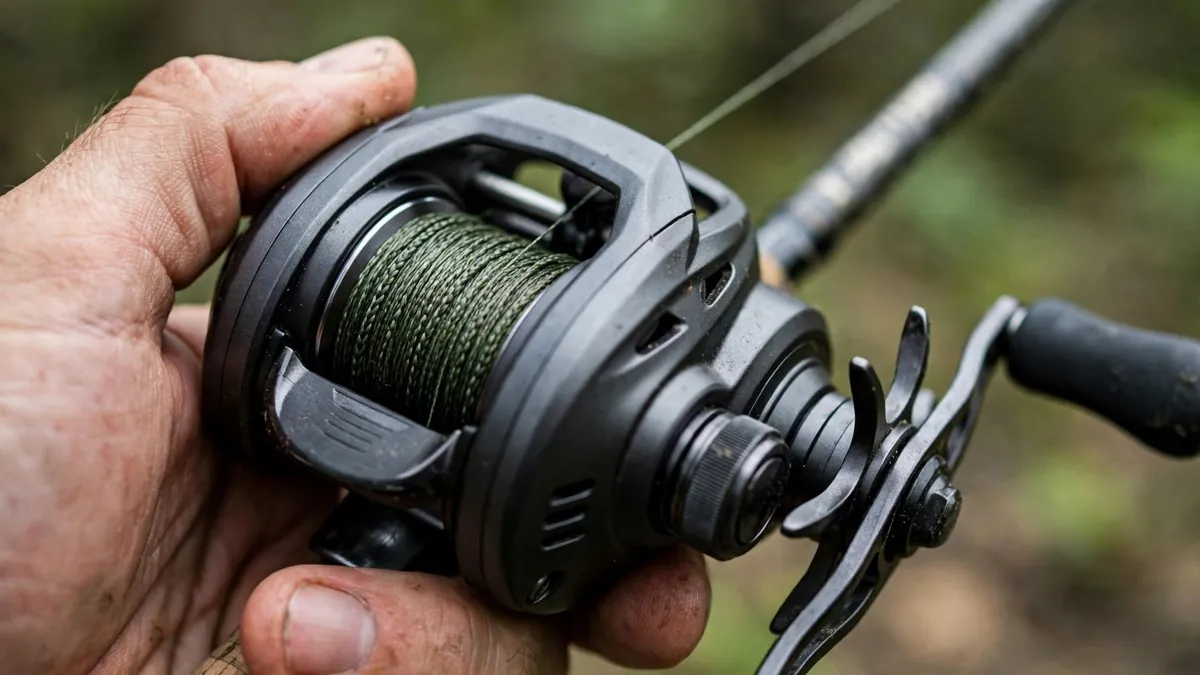
Spool 12 lb mono to learn; it is cheap enough that a cut-out backlash does not sting. Once your thumb control is automatic and nests are rare, move to braid or fluoro. Trade-offs in my my line comparison guide guide.
Mistake 9 of 11 · Practice
9. Skipping practice and going straight to the water
The most predictable way to ruin a first trip with a new baitcaster is to make your first hundred casts while also trying to catch fish. Casting at targets on grass teaches thumb timing without pressure, wind surprises, or lost lures. Nearly every forum thread says the same: practice in a yard first.
Do one session of 100 to 150 casts at a bucket 20 to 30 feet away with a half-ounce casting plug. Then practice landing accuracy, because stopping the spool at a target is the skill that prevents end-of-cast nests. The plan is in how to cast a baitcaster, the progression in the beginner progression, and Take Me Fishing’s how-to-cast page covers the same fundamentals.
Mistake 10 of 11 · Adjusting
10. Changing lure weight without re-tuning anything
You dialed in the reel on a half-ounce jig, tied on a weightless worm, and suddenly it backlashes like you never learned anything. Nothing broke: the settings that were perfect for the heavier lure are wrong for the lighter one. This is the mistake that makes beginners think their reel is defective.
Every meaningful weight change gets a re-tune: drop test the tension, set the brakes, then make two or three test casts before fishing. A minute at the tackle box saves the nest that wastes ten. Related: different techniques often want different gear ratios, which is why many anglers own more than one baitcaster.
Mistake 11 of 11 · Gear
11. Buying an ultra-cheap reel that fights you
A baitcaster is a precision tool, and the braking system is the difference between a forgiving teacher and a random number generator. Ultra-cheap no-name reels with vague, mushy brakes make every mistake on this list worse, because you cannot tell whether the backlash was your fault or the reel’s. Budget reels from real brands like the Abu Garcia Black Max or the Shimano SLX A have predictable, linear braking.
If you already own a bottom-tier reel and keep struggling, put the money toward a real entry-level reel with a real braking system instead of buying accessories for it. Our best baitcasting reel for beginners roundup matches forgiving brakes to price points, and my Shimano SLX A 150 review explains why that reel is such a forgiving teacher.
Buy From Amazon Buy From Amazon
What the thin ranking listicles miss
The Q and A stubs. Two pages from en.pescador.com.pt answer “what are common mistakes” with five or six bullets and one-line fixes: no ranking by severity, no sequencing, and no explanation of which setting controls which phase of the cast.
The charter-blog post. A livepositively.com article lists real mistakes with decent advice, but it is written around salmon and halibut charter trips: heavy boat gear, not a beginner on a pond with a bass setup.
The generic beginner-fishing lists. Ardent Outdoors and AnglersCircle rank beginner-mistake content about fishing in general: bait choice, retrieve speed, moving spots. None of it touches baitcaster mechanics, so none of it answers a question about a spool, a brake, or a thumb.
What none of them do. No competitor ranks mistakes by cost, sequences fixes in the order that matters (tension first, brakes second, thumb always), or maps each mistake to where in the cast it strikes: launch (tension and brakes), mid-flight (lure weight and wind), or landing (thumb). Backlashing at launch? Mistakes 1 and 2. Mid-flight? 4 and 6. Landing? 5. The rest is maintenance.
Beginner baitcaster FAQs
Why does my baitcaster keep backlashing?
Your spool is outrunning your lure because the tension is too loose, the brakes are too low, your thumb never slows the spool, or you cast into a headwind without adding brake. Fix the tension with the drop test first, start brakes at 70 percent, and stop the spool with your thumb before the lure lands.
What is the best brake setting for beginners?
Start at 70 to 80 percent of maximum braking on a magnetic or dual-brake reel, and back it down one click at a time only after consecutive clean casts. Short, clean casts beat long, tangled ones.
Why does my baitcaster backlash at the end of the cast?
That is thumb timing: the lure slows or lands while the spool keeps turning. Keep your thumb close to the spool through the cast and press it down firmly before the lure reaches its target, not after.
What line should I put on a baitcaster as a beginner?
Twelve-pound monofilament: cheap, forgiving, and easy to pick out of a backlash. Learn on mono, then move to braid or fluorocarbon once your thumb control is automatic.
How long does it take to learn to cast a baitcaster?
Most beginners cast cleanly in a yard within one focused practice session of 100 to 150 casts, and cast confidently on the water within two or three trips. The learning curve collapses once you stop skipping the spool tension setup.