Line Guide · 2026
Braid vs Fluorocarbon on a Baitcaster: Which Line and When
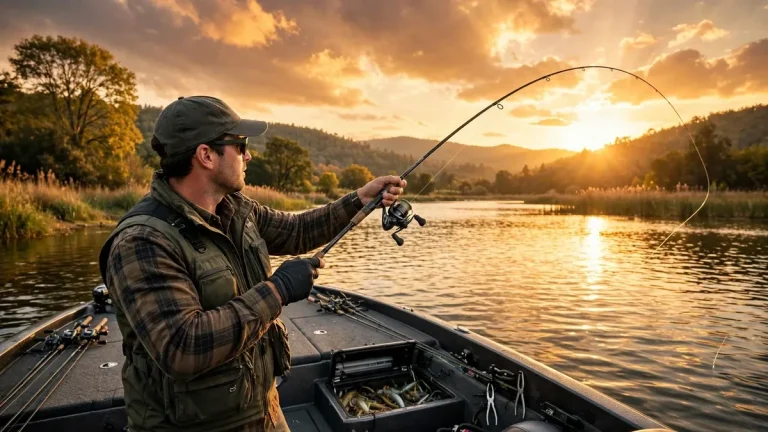
Here is the short version, because this is one of those questions with a real answer. Braid wins on a baitcaster whenever power and feel matter: frogging, flipping, punching, topwater. Fluorocarbon wins whenever stealth and abrasion resistance matter: jigs, crankbaits, clear water, fishing around wood and rock. And the smartest setup most days is neither straight line. It is braid with a fluorocarbon leader, which gives you the casting distance and sensitivity of braid with the invisibility of fluoro right where the fish sees it.
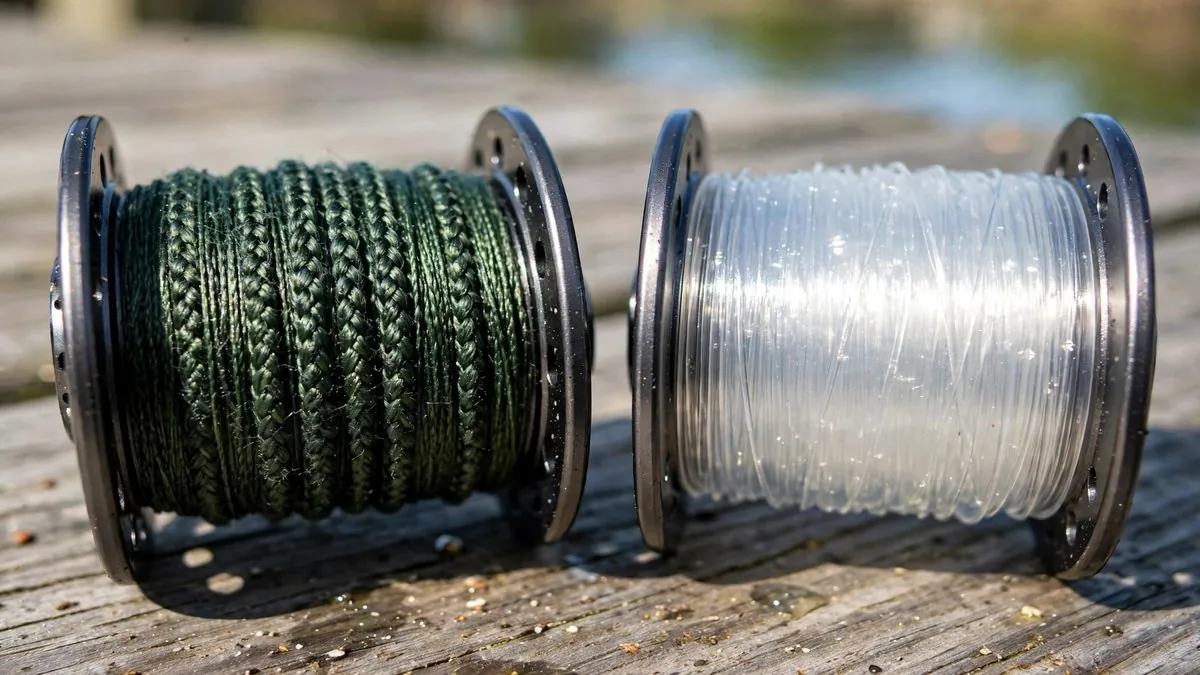
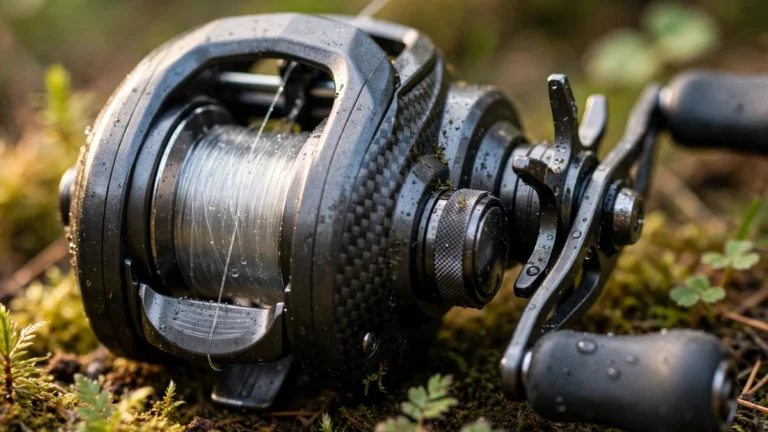
I have spooled both lines on baitcasters for years and fished them side by side. The generic charts miss the real story: on a small baitcaster spool, braid digs in under load and slips on bare metal, while fluorocarbon coils with memory and punishes sloppy winding. Learn those personalities and the choice becomes a technique decision.
Everything below is baitcaster specific: dig-in, memory, backlash behavior, and leader knots, technique by technique.
Braid vs fluorocarbon: side by side
The numbers in one place:
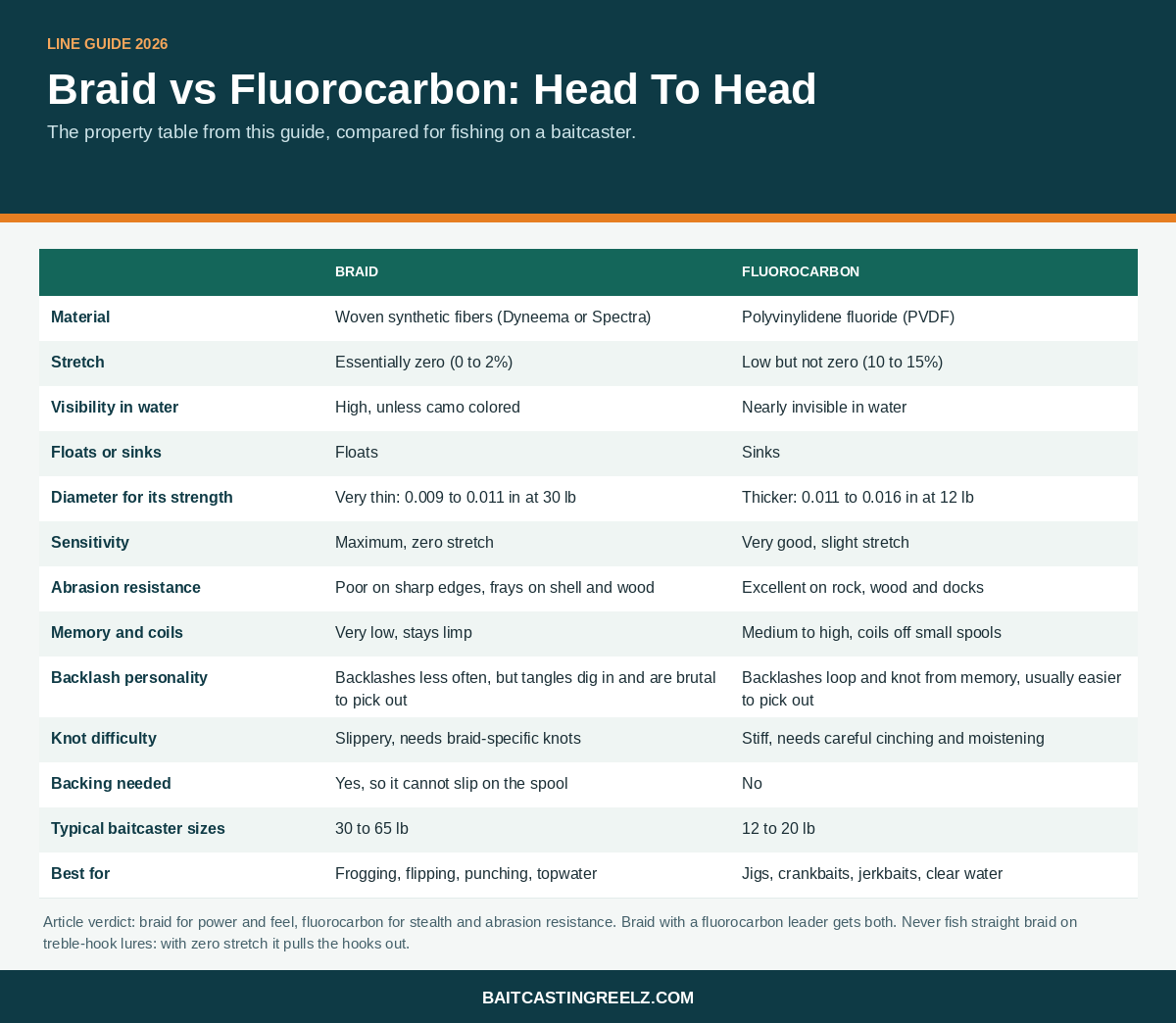
| Property | Braid | Fluorocarbon |
|---|---|---|
| Material | Woven synthetic fibers (Dyneema or Spectra) | Polyvinylidene fluoride (PVDF) |
| Stretch | Essentially zero (0 to 2%) | Low but not zero (10 to 15%) |
| Visibility in water | High, unless camo colored | Nearly invisible, light refraction close to water |
| Floats or sinks | Floats | Sinks |
| Diameter for its strength | Very thin, about 0.009 to 0.011 in at 30 lb | Thicker, about 0.011 to 0.016 in at 12 lb |
| Sensitivity | Maximum, zero stretch | Very good, slight stretch |
| Abrasion resistance | Poor on sharp edges, frays on shell and wood | Excellent on rock, wood, docks |
| Memory and coils | Very low, stays limp | Medium to high, coils off small spools |
| Backlash personality | Backlashes less often, but the tangles dig in and are brutal to pick out | Backlashes loop and knot because of memory, easier to pick than braid usually |
| Knot difficulty | Slippery, needs braid-specific knots | Stiff, needs careful cinching and moistening |
| Backing needed | Yes, mono or fluoro wraps so it cannot slip on the spool | No |
| Typical baitcaster sizes | 30 to 65 lb | 12 to 20 lb |
How braid behaves on a baitcaster
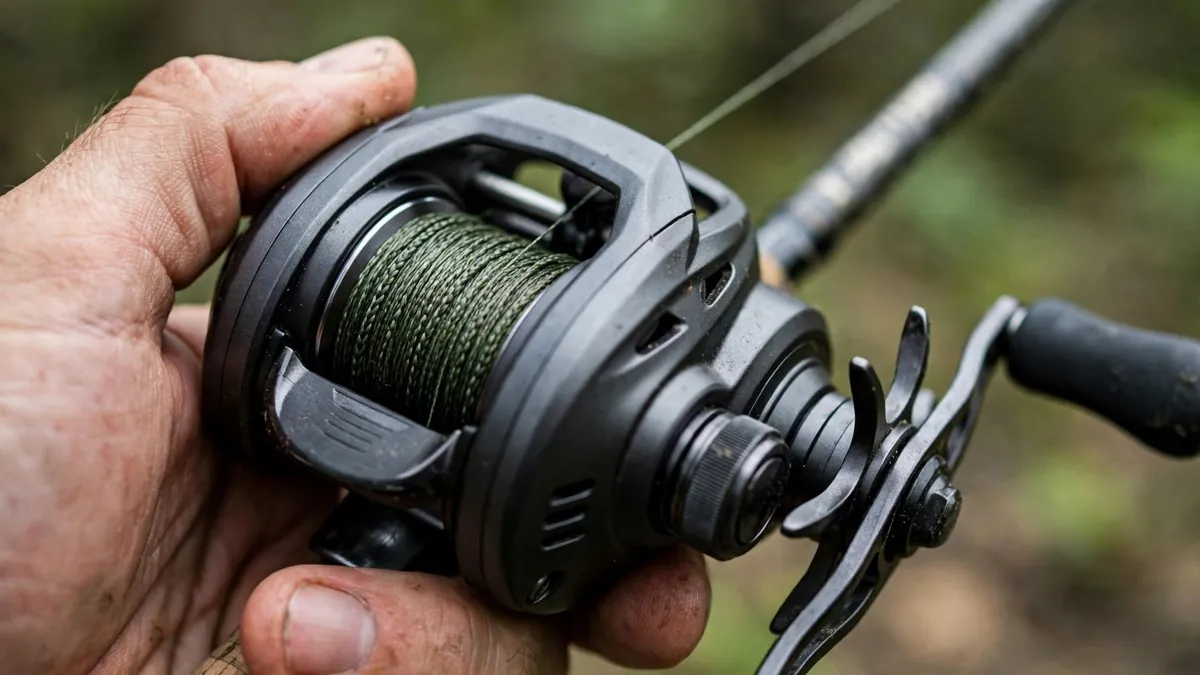
Braid on a baitcaster is about efficiency: thin diameter means longer casts, and zero stretch means you feel every rock and tick. For power techniques that is unbeatable. Fifty-pound braid over matted grass sets a frog hook at long range and winches fish out of cover that would bury fluorocarbon.
Braid has two habits that cost anglers fish, and both are baitcaster specific. The first is dig-in: hard pressure over loosely wound line drives the thin wraps down between the ones beneath, after a violent hookset, a snag pull, or a hard run. After any of those, free-spool a cast’s worth of line and reel it back on under tension. Twenty seconds of habit that prevents the locked-spool cast. The second is slipping on the spool: braid is too slick to bite bare metal, so wind it over a few wraps of mono or fluoro backing first, as in my spooling guide. Skip that and your drag will feel broken at the worst moment.
Braid’s other honest weakness is abrasion. It cuts through vegetation beautifully, but shell beds and splintered wood chew it, which is why the jig section recommends fluorocarbon.
How fluorocarbon behaves on a baitcaster
Fluorocarbon on a baitcaster is about stealth and contact. Its refractive index sits close to water, so it disappears in clear water in a way braid never will, and its abrasion resistance around rock, wood, and docks is genuinely excellent.
Fluorocarbon’s personality is memory: it holds the spool’s coil shape, so it can jump off an overfilled or loosely wound spool, its backlashes loop and knot, and its knots must be cinched slowly, moistened, and tested. Fluoro also sinks: a feature for crankbait depth and slack-line presentations, a bug for topwater, where it drags the lure’s nose down.
One qualifier on sensitivity that a forum regular once put perfectly: braid is only the most sensitive line on a tight line. On slack-line presentations where you watch the line for movement, fluorocarbon’s density and straight sink keep it readable in a way floating braid is not. Tight-line sensitivity goes to braid; slack-line readability goes to fluoro.
The technique decision matrix: which line, and when
Forget “which line is better.” Ask which line the technique needs.
| Technique | Line call | Size I fish | Why |
|---|---|---|---|
| Frogging over mats and slop | Straight braid | 50 to 65 lb | Zero stretch for long hooksets, cuts through vegetation, floats |
| Flipping and pitching heavy cover | Straight braid | 50 to 65 lb | Instant hooksets, winches fish out of thick cover |
| Punching mats | Straight braid | 65 lb | Maximum strength per diameter, cuts through mats |
| Jigs and Texas rigs, bottom contact | Straight fluorocarbon | 14 to 17 lb | Abrasion resistance on rock and wood, invisible, great bite detection |
| Crankbaits | Straight fluorocarbon | 12 lb (10 lb for extra depth) | Thin enough for diving depth, sinks, slight stretch keeps trebles pinned |
| Jerkbaits | Straight fluorocarbon | 12 lb | Stays slack for the pause, invisible in clear water |
| Topwater treble baits (poppers, walking baits) | Braid or mono, not fluoro | 30 to 40 lb braid | Braid floats so lure action stays alive; fluoro drags the nose down |
| Buzzbaits and prop baits | Braid with a short mono leader | 30 to 50 lb braid, 12 to 16 in of 15 to 20 lb mono | Limp braid wraps on blades, so a short leader keeps it clear |
| Treble-hook reaction baits in general | Fluorocarbon or mono, avoid straight braid | 12 lb fluoro | Zero stretch pulls trebles free on the strike |
| Clear water, pressured fish | Braid main line to fluorocarbon leader | 30 to 40 lb braid, 12 to 15 lb leader | Braid’s distance and feel, fluoro’s invisibility where it counts |
| Spinnerbaits and chatterbaits | Straight fluorocarbon or braid-to-leader | 14 to 17 lb fluoro | Slight stretch and abrasion resistance suit single-hook moving baits |
| Learning the reel | Monofilament first | 12 lb | Cheapest, most forgiving backlashes; graduate to fluoro, then braid |
Two rows deserve extra explanation. First, never fish straight braid on treble-hook lures. With zero stretch, a hard strike pulls the hook free instead of the line giving. The slight stretch of fluorocarbon or mono keeps trebles pinned. Second, the buzzbait row: limp braid wraps around blades and props mid-cast, so a short 12 to 16 inch stiffer mono leader between braid and lure keeps the line clear.
The braid-to-leader hybrid: getting both
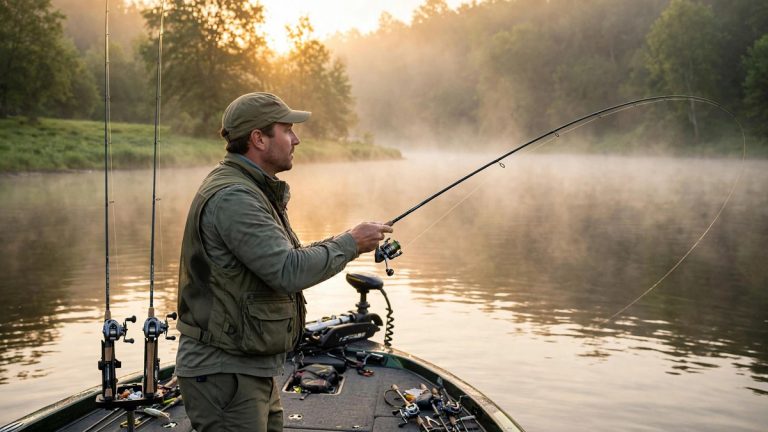
The hybrid is simple: braid main line for distance and feel, with 6 to 10 feet of fluorocarbon leader at the business end for invisibility and abrasion resistance. It is the most versatile setup on a baitcaster, and what I fish when I can only take one rod to a new lake.
The connection knot is the whole game: a bulky knot clunks through the guides and kills distance. Learn the FG knot (slimmest) or the double uni (easier, bulkier). One useful fact: 30 lb braid and 12 lb fluorocarbon are roughly the same diameter (about 0.011 inches), and line-to-line knots hold best when the lines are close in thickness. Keep leaders six to ten feet, retie when abraded, and check the knot after every snag.
Which line backlashes worse on a baitcaster
Fluorocarbon’s memory means it loops and knots when too much line pays out, so fluoro backlashes look spectacular but are usually pickable. Braid backlashes less often, but when it nests, the thin line digs in and welds into a knot that sometimes only scissors will solve. The ranking from my hands: mono backlashes are easiest to pick out, fluorocarbon is in the middle, braid is hardest. One more reason beginners learn on mono, and why my backlash prevention guide pairs technique fixes with line advice.
Spooling each line right on a baitcaster
For braid, wind it over a few wraps of mono or fluoro backing so it cannot slip, and keep firm, even tension throughout. For fluorocarbon, wind it on tight and even, fill to about 1/8 inch below the spool lip, and never overfill, because overfilled fluoro springs off in coils. The full step-by-step is in my spooling guide. Replace fluorocarbon when nicked; strip and respool braid when the working end frays.
What other line guides miss
I read the top results before writing, and they all stop one step short. The generic pages give a braid-mono-fluoro spec table with nothing about baitcaster spool behavior: no dig-in, no memory loops, no note on which backlash is pickable. Interview-style articles offer brand preferences but never organize advice by technique. Forum threads hold the real gold, the slack-line sensitivity argument, the dig-in fixes, the knot debates, but scattered across dozens of posts with no structure.
Missing everywhere: a technique-by-technique matrix built for baitcasters, with the spool mechanics that decide whether a line works on this reel. That is this article.
Braid vs fluorocarbon FAQs
Can you put straight fluorocarbon on a baitcaster?
Yes. Twelve to 20 lb straight fluorocarbon suits jigs, crankbaits, and bottom contact, where invisibility and abrasion resistance matter. The trade-off is memory: fluoro coils off small spools. Spool it tight, filled to about 1/8 inch below the rim. Beginners should start on mono.
Does braided line work on a baitcaster?
Yes, and for heavy cover it is the standard. Braid casts far, has nearly zero stretch for instant hooksets, and cuts through vegetation. Wind it over backing so it cannot slip, spool it tight to prevent dig-in, and size generously: 30 lb all-around, 50 to 65 lb for frogs and cover.
What line should I use on a baitcaster for bass?
Match the line to the technique: braid (30 to 65 lb) for frogs, flipping, punching, and heavy cover; straight fluorocarbon (12 to 20 lb) for jigs, crankbaits, jerkbaits, and clear water; braid with a fluoro leader for versatility. See my baitcaster setup guide for the full picture.
Should I use a fluorocarbon leader with braid on a baitcaster?
In clear water, yes. You keep braid’s distance and sensitivity with fluorocarbon’s invisibility at the lure. Use an FG knot for the slimmest profile or a double uni for simplicity; 30 lb braid pairs cleanly with 12 lb fluoro.
Does braid or fluorocarbon cast farther on a baitcaster?
Braid usually wins: thinner per pound of strength with very low memory, so it leaves the spool cleanly. Fluorocarbon’s stiffness adds friction. If distance is the priority and the water is not clear, braid is the call.
Why does my braid dig into itself on the spool?
Hard pressure over loosely wound line: a violent hookset, a snag pull, or a hard run. Spool under firm, even tension, and after any heavy pull, free-spool a cast’s worth of line and reel it back on tight. Good setup habits prevent most of it.
Verdict
Stop asking which line is better and ask what the technique needs. Braid for power: frogs, flipping, punching, topwater, thick cover. Fluorocarbon for stealth and contact: jigs, crankbaits, jerkbaits, clear water. Braid with a fluorocarbon leader when you want both. Never put straight braid on treble hooks, and spool both under real tension.
For the core properties of each line type, Take Me Fishing’s types of fishing line guide is a solid independent reference.
© baitcastingreelz.com · Editorial note: line recommendations reflect bass baitcaster techniques as of 2026. Line properties and product lineups change, so verify pound test and diameter on the spool label before buying.