Bass technique guide · US anglers
When to Use Frog Baits for Bass
The short answer to when to use frog baits for bass: tie one on whenever bass are holding shallow under vegetation or shade and other lures cannot travel through it cleanly. Frogs are not just a dawn-and-dusk trick — some of the most violent blow-ups of the year happen at high noon, when bass tuck under matted grass for shade and a frog is the only bait that can walk across their ceiling.
By baitcastingreelz.com · Updated 15 October 2026 · 12-minute read
The quick answer
Do not overthink the clock. Midday heat pushes bass tighter under the thickest cover, which is exactly where a frog excels. If the water and cover make a weedless surface bait the cleanest presentation, it is frog time. For the bigger picture on finding shallow bass, start with our guide on how to catch bass.
When frog baits earn a place in the rotation
When the grass mats up (late spring through fall)
As surface vegetation thickens from May onward, open-water lures start collecting salad on every cast. A hollow-body frog like the Spro Bronzeye or Booyah Pad Crasher glides across mats, hydrilla and lily pads that would destroy a crankbait. But do not wait for full mats — scattered grass edges and pad fields fish just as well.
When the sun is high and bass want shade
The midday frog bite is real. On bright, hot afternoons, bass slide under the thickest mats, docks and laydowns for shade. The shade line — that hard edge between dark cover and lit water — is the highest-percentage casting target of the day.
When fish are shallow and looking up
Post-spawn and summer bass cruising grass edges, bluegill beds and baitfish schools will rocket to the surface. Low light, cloud cover and wind-protected pockets all help, but position beats prediction: cast the frog where bass can ambush without leaving cover, and you do not need a “magic hour.”
When you need a slow, stubborn target
A frog can sit motionless in a single hole in the mat, then crawl six inches. That patience gives buried bass time to locate the bait — something a spinnerbait ripping past at speed never offers. In dense cover, slow is usually better than fast.
Where to throw a frog bait
Every cast should have a destination: pad gaps, grass points, torn mat edges, dock shade lines, laydown corners and small holes in the vegetation.
| Cover situation | Best starting approach | What to watch |
|---|---|---|
| Dense mat | Drag the frog slowly; pause at every hole. | Subtle boils, mat movement at the edge, a fish tracking the bait. |
| Lily pads | Walk it across pad tops, then stop at each opening. | Ambush points where pads meet open water. |
| Scattered grass | Steady walk or short pops through lanes. | Clean travel lanes and isolated clumps. |
| Dock or bank shade | Skip or cast into the shade and work slowly outward. | The darkest edge and the first transition back to light. |
Frogs are one branch of a much bigger bait family — for practical bait-selection context, see our guide to different types of fishing baits. Choosing by the job the lure must perform keeps every decision simple.
Match the retrieve to the cover
Walk it in open pockets and along edges
Short, controlled rod twitches make a hollow-body frog glide side-to-side — the classic “walk the dog” on the surface. This is the retrieve for pad fields, open pockets in the grass and shade edges, anywhere the bait has room to move.
Drag it across heavy cover
On a matted surface, slow down. Drag the frog steadily enough that it does not tumble, and stop it wherever the cover changes: a hole, a torn edge, a grass point, a darker patch. Most mat strikes happen during the pause, not the pull — a frog sitting in a hole looks like the easiest meal a buried bass will see all day.
Pop it where sound can help
A popping frog like the Lunkerhunt Popping Frog spits water and draws attention around sparse cover and open pockets. One or two measured pops, then a long pause. Constant chugging without pauses gives bass less time to locate the bait and more reason to swipe at it instead of eating it.
Size and colour choices that matter
Most hollow-body frogs run 2.25 to 2.75 inches and 1/2 to 5/8 oz — go smaller and lighter over thin cover, bigger and heavier when you need casting distance into thick mats. Colour rules are simple: black for overcast days, stained water and night fishing (it throws the strongest silhouette); white or chartreuse belly patterns for clear water and bright sun so you can track the bait. Soft-plastic toads like the Zoom Horny Toad, rigged on a 5/0 EWG hook with a weighted swimbait hook, are a faster alternative for covering sparse grass — burn them across the tops.
Optional supply: hollow-body frog baits
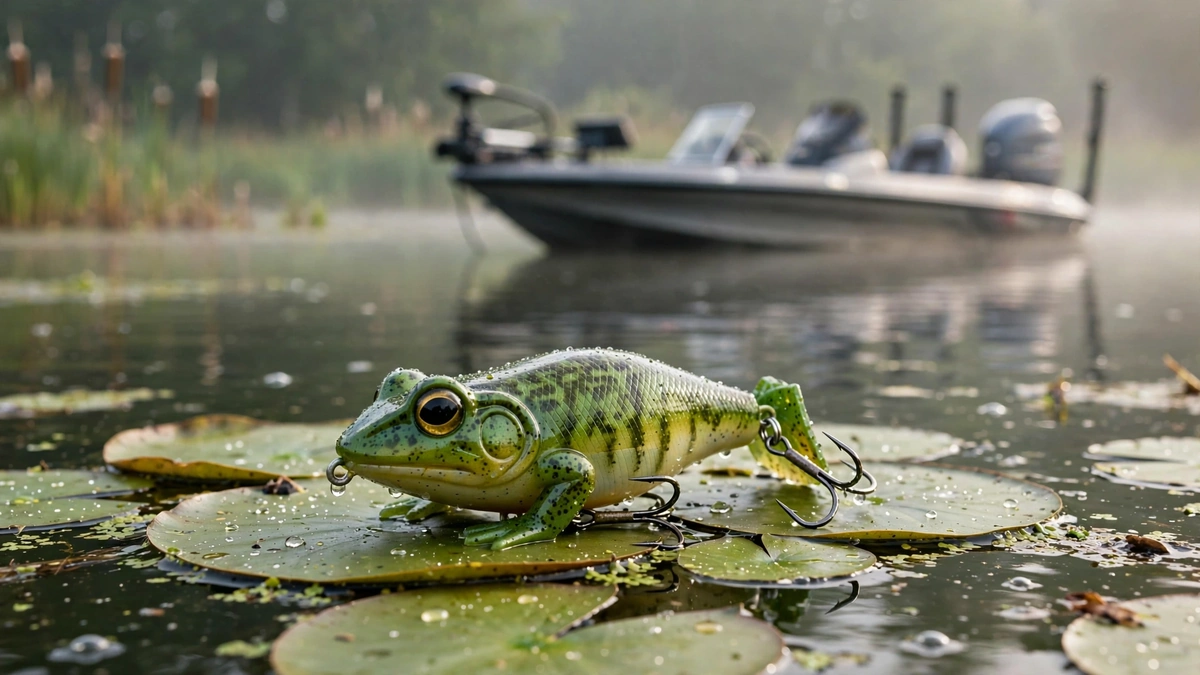
A small selection of hollow-body frog styles — a walker, a popper and one soft toad — covers dense mats, pad fields and open pockets without turning a technique guide into tackle overload.
What to do when a bass blows up on the frog
Getting the strike is the easy part — connecting is where frog fishing is won or lost. A bass may knock the frog sideways, strike through a mat before it has the bait fully, or turn with it without committing. The reflex hookset is the number-one cause of missed frog fish.
- See or hear the strike. Drop the rod tip and resist the urge to swing immediately.
- Take up line as the fish commits. Reel until you feel solid weight or steady pressure — the fish telling you it has the bait.
- Set with firm, controlled pressure. Sweep the rod hard to the side to drive the double hooks home and keep the fish moving out of cover.
- Keep pressure all the way to the boat. Give a bass slack for one second and it will bury back into the mat it came from.
A miss is information, not failure. Pause the frog in the same spot — the fish often comes back. If it misses twice, follow up with a compact 3/8 oz jig dropped into the opening; a bass that refused the frog will frequently eat the jig. See how to jig fish for the follow-up retrieve.
Build a setup that controls fish in cover
Frog fishing punishes light tackle. The standard setup: a 7′ to 7’6″ heavy-power, fast-action rod for leverage, a baitcasting reel with a 7.3:1 or faster gear ratio to take up line quickly after the strike, and 50 to 65 lb braided line — braid does not stretch, which means instant hooksets and the power to drag a bass out of a mat. Set your drag firm and check it before the first cast, not after a five-pounder buries in hydrilla.
For equipment selection, our guide to the best baitcasting rods covers rod-fit considerations. If you are still learning baitcasting control, start with these baitcaster tips for beginners and learn how to adjust a baitcasting reel before launching heavy frogs into the thick stuff.
Fix common frog-fishing problems
| Problem | Likely reason | First adjustment |
|---|---|---|
| Frog keeps fouling | Wrong travel route, damaged bait or too much speed. | Work cleaner lanes; check the bait’s legs and hook points; slow down. |
| Bass strike but do not connect | Hookset too early, or the fish cannot take the bait through cover. | Wait, feel weight, then set firmly; bend hook points slightly up for better exposure. |
| No strikes on a productive-looking mat | Fish are in the holes and edges, or holding below the mat. | Target irregularities; extend the pauses; follow up with a punching jig. |
| Fish buries in grass | Too little pressure or too light a setup for the cover. | Step up to heavier braid and keep steady pressure from the hookset. |
Keep notes on cover type, time of day, retrieve and what got bit. These broader bass fishing tips can help turn one frog blow-up into a repeatable shallow-water pattern.
Frequently asked questions
When should you throw a frog bait for bass?
Throw a frog whenever bass are using surface cover — matted vegetation, pads, grass edges, docks and shade — and the cover is too thick for treble-hooked lures. In most of the country that window runs from May through October, whenever water temps are 65°F and up.
Do frog lures work in the middle of the day?
Yes — midday can be prime frog time. Bright sun pushes bass under the thickest mats and docks for shade, and a frog walking across that cover is often the only presentation that can reach them. Target shade lines and openings.
Why do bass miss a frog bait?
They often strike to stun the bait, misjudge it through cover, or turn with it without fully committing. The fix is discipline: drop the rod tip, reel until you feel solid weight, then set hard.
What line should you use for frog fishing?
50 to 65 lb braided line is the standard for hollow-body frogs in vegetation — zero stretch for solid hooksets and the strength to pull bass out of mats. Drop to lighter braid only when fishing frogs over open water with minimal cover.
What rod is best for frog fishing?
A 7′ to 7’6″ heavy-power, fast-action rod paired with a 7.3:1 or faster baitcasting reel. The backbone moves fish out of cover, and the fast retrieve takes up slack quickly after long casts.
Affiliate disclosure: baitcastingreelz.com participates in the Amazon Associates Program and may earn from qualifying purchases. The optional link is for convenience and does not affect editorial guidance.