How to Cast a Baitcaster Further: The 7-Step Distance Tune-Up
If your casts feel short, the fix is rarely a new reel. To cast a baitcaster further, set your spool tension with the drop test and then back it off slightly, lower your brakes one click at a time, spool thinner line to about 1/8 inch below the spool lip, and match your lure weight to the middle of your rod’s rating. Then start the cast with more line out and use a smooth, two-handed motion with a high release. Work through those changes in that order and most anglers gain distance without buying anything.
I see the same pattern every season. Someone buys a capable reel, leaves every setting where the factory put it, and then wonders why a buddy with an older setup outcasts them. Distance is not one secret. It is a chain of small things, and the weakest link decides how far your lure flies. This guide works through the chain in the order I would check it on my own gear. If you are still learning the basic motion, start with our guide on the basics of casting a baitcaster and come back here once the cast itself feels comfortable.
What Actually Limits Your Casting Distance
A baitcaster cast is a tug of war. Your lure pulls line off the spool, and everything that slows the spool or the line steals distance. The brakes slow the spool. The tension knob slows the spool. Thick line drags through the guides and the air. A rod too stiff for the lure never loads, so it never unloads with any spring. Even the wind pushes back on bulky lures.
That framing tells you where to look first. Mechanical friction, the settings, is cheapest to fix and usually steals the most. Then comes the line, then the rod and lure match. Technique sits on top of all of it, because good technique cannot rescue a reel choked down with brakes, and perfect settings cannot rescue a jerky, muscled cast. The tune-up below follows that order.
Step 1: Set Spool Tension With the Drop Test, Then Back It Off
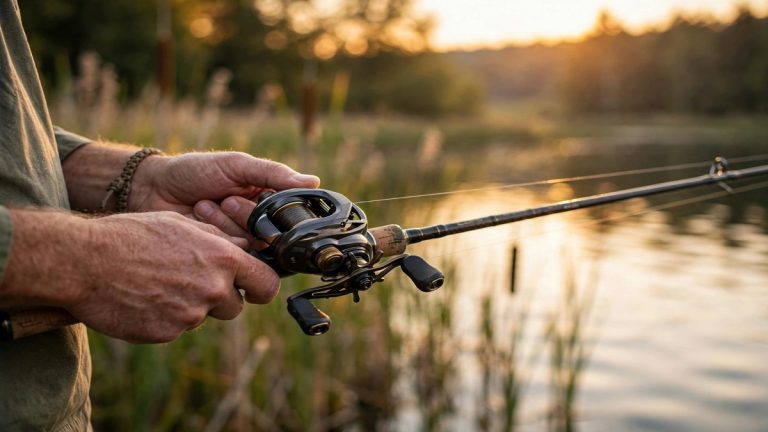
Spool tension is the small knob on the handle side of the reel, next to the spool. It presses on the end of the spool shaft, and it is the first thing I check. The standard setup is the drop test, and it takes ten seconds:
- Tie on the lure you actually plan to throw, not a practice plug of a different weight.
- Hold the rod tip up at about 45 degrees, click the spool free, and let the lure hang.
- Loosen the tension knob until the lure falls slowly and steadily to the ground, without the spool overrunning when it lands.
- Now back the knob off one or two small clicks more. That last bit of looseness is where your extra distance lives.
The classic drop test setting is a safe starting point, but it is a touch too tight for maximum distance. Those final clicks matter because the tension knob works against the spool for the whole cast, start to finish. Change it in small steps and take a few practice casts to find your edge. Our walkthrough on adjusting your baitcasting reel covers the knob and both brake types in more detail.
Step 2: Back the Brakes Off One Click at a Time
Brakes exist to control the spool early in the cast, when it spins fastest and a backlash is most likely. The problem is that most anglers set them once, usually high, and never touch them again. Every click of brake you do not need is distance you are giving away on every single cast.
With a magnetic brake dial, drop the setting by one number, make five or six casts, and only then drop it again. With centrifugal brakes, turn off one pin at a time, preferably opposite the one you turned off last so the spool stays balanced. Stop at the first sign of loose line on the spool mid-cast, then go back up one step. That setting, one click above trouble, is your distance setting for that lure.
Two honest warnings. First, this only works if your thumb keeps learning. Brakes and tension are training aids, and the real goal is a thumb that feathers the spool on its own, the same skill that keeps you out of trouble in our guide on preventing backlash. Second, brake needs change with the lure. A compact 1/2 oz jig flies clean and needs little braking. A wide crankbait catches air, slows fast in flight, and needs more brake. If a part name here is unfamiliar, the labelled diagrams in our parts breakdown will sort it out.
Step 3: Fix the Line, Because Diameter Is a Distance Factor
Line is the most underrated distance factor on the whole list. Thinner line slips through the guides with less friction, cuts the air better, and lets the spool spin up faster. If you are throwing 65 lb braid or 20 lb fluorocarbon for general bass fishing, you are paying for that thickness on every cast. Most bass work is done well on 30 to 40 lb braid or 12 to 15 lb fluorocarbon, and stepping down within what your cover allows is free distance. Our breakdown of which pound test to run matches line strength to technique if you want the full chart.
Fill level matters too, and this is where advice online contradicts itself. Some guides say a half-full spool casts further because it weighs less. Others say a full spool casts further. The second camp is closer to right for most of us. A nearly empty spool has a small effective diameter, so it has to spin more times to release the same length of line. Fill the spool to about 1/8 inch below the lip. That keeps the diameter large without packing line so tight it digs in. If your spool has been fished down after a season of break-offs and retying, your casts have been getting shorter all year without you noticing. Our spooling guide shows how to fill the spool to the right level under even tension.
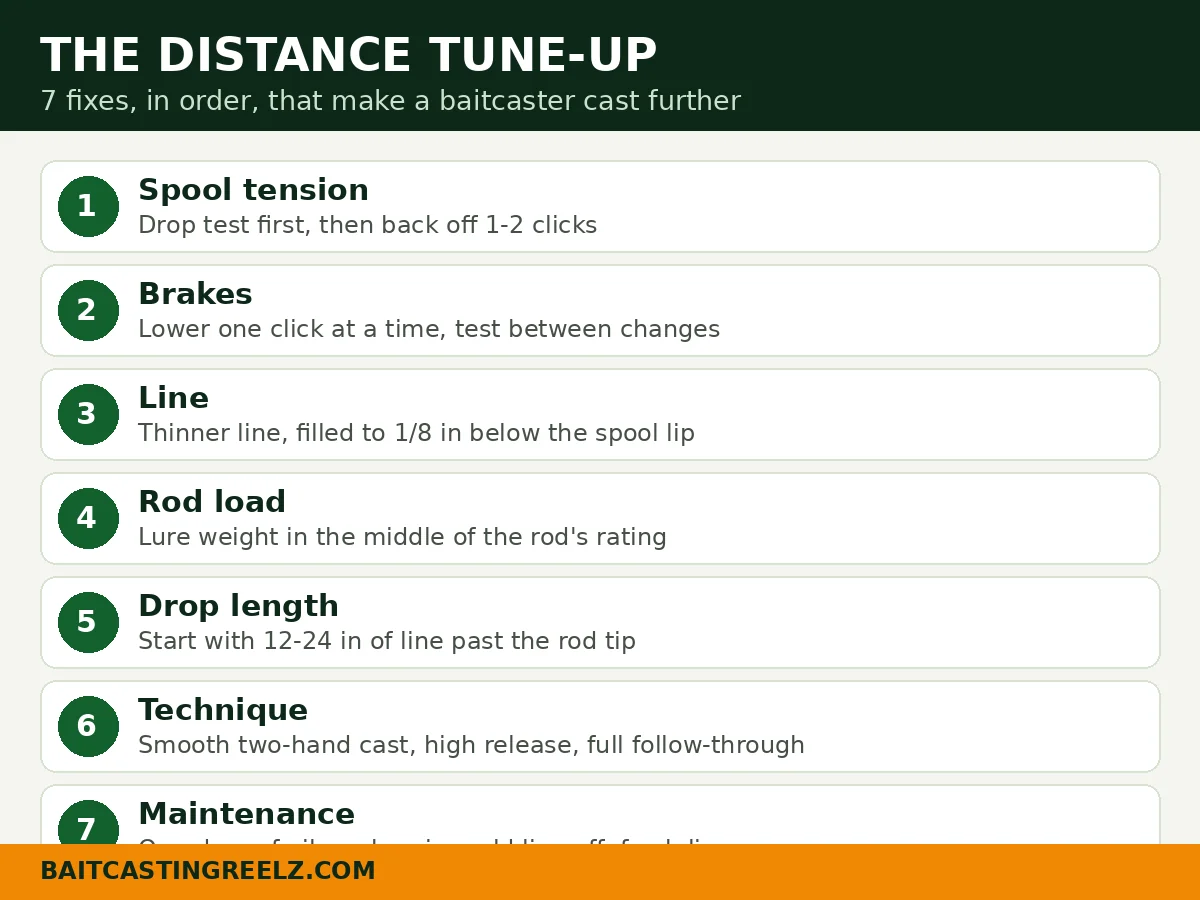
Step 4: Match the Lure to the Middle of the Rod’s Rating
Every casting rod prints a lure weight rating on the blank, something like 1/4 to 3/4 oz. That range is not decoration. A lure near the bottom barely bends the rod, and a rod that does not load cannot spring back and launch the lure. A lure near the top overloads it and feels sloppy. The longest casts usually come from the middle of the rating.
Shape matters almost as much as weight. A 1/2 oz jig or lipless crankbait slices through the air. The same weight in a wide crankbait or big-bladed spinnerbait acts like a parachute, which is why those lures feel like they cast shorter than they should. Distance specialists choose aerodynamic lures on purpose, and the reels in our crankbait reel guide guide are built around exactly this kind of longer casting. If your favourite lure is an air-catcher, accept the trade or throw it on a longer rod, which brings us to technique.
Step 5: Start With More Line Out and Let the Rod Load
Most anglers start a cast with the lure hanging 6 to 8 inches below the rod tip. Try 12 to 24 inches instead. A longer drop puts the lure on a bigger swing arc, which builds more rod load and more lure speed for the same effort. For light lures it is almost mandatory. A 1/4 oz bait on a short drop never gets the rod working. On a longer drop, the same bait loads the tip and leaves with pace.
Pair that with a back cast that actually bends the rod. Drift the rod back smoothly and let the lure’s weight pull the tip into a bend before you start forward. If you snatch the rod back and forth, the tip never loads and you are throwing with your arm alone. Arm-only casts are short casts, and they cause most of the wild casts that end in backlashes.
Step 6: Cast Smooth, Release High, and Follow Through
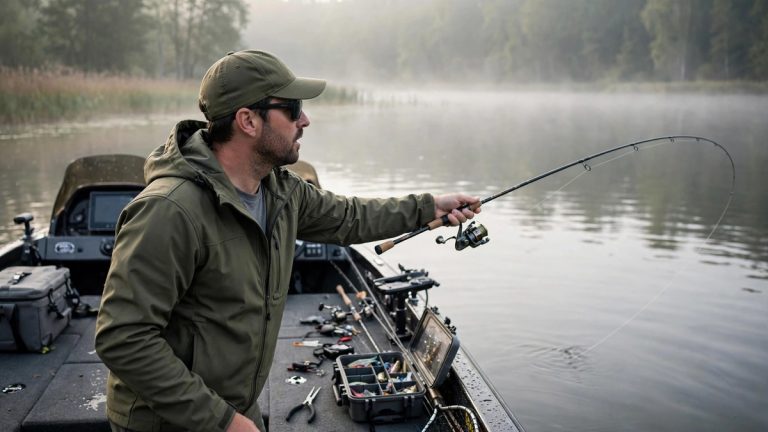
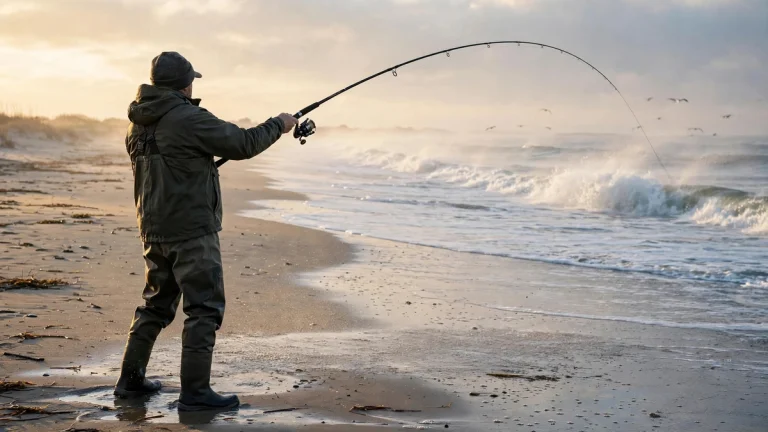
For open-water distance, the two-handed overhead cast is the tool. Both hands on the rod, a smooth acceleration rather than a hard snap, and a release that sends the lure out on a rising line instead of driving it down at the water. Build speed all the way through, fastest at the very end, like cracking a whip rather than throwing a punch. A longer rod, 7 feet 3 inches and up, gives the lure a bigger arc and more tip speed, which you can feel on the first cast.
Then hold the follow-through. Rod pointed at the target, thumb hovering just over the spool, feathering lightly if the lure starts to slow. Cutting the follow-through short and dropping the rod early pulls energy out of the cast and pulls the lure down with it. Several of the habits in our list of the mistakes every beginner makes are exactly these small technique leaks, and fixing them costs nothing.
Wind deserves one honest paragraph. Into a headwind, add a click or two of brake, keep the trajectory flat, and choose compact, heavier lures. With the wind behind you, do the opposite and enjoy it, because a tailwind is the one free upgrade in fishing. No setting beats weather, only settings that respect it.
Step 7: Clean Bearings and Fresh Line Finish the Job
If your reel used to cast further than it does now, this step is probably your answer. Bearings pick up grit, old oil thickens, and mono and fluorocarbon develop memory coils that slap through the guides. A spool that does not spin freely by hand will not spin freely behind a lure.
The maintenance rules are simple. Grease goes on gears. Oil goes on bearings, and one drop per bearing is enough. Over-oiling is a common mistake, because flooded bearings spin slower, not faster, and a freshly serviced reel sometimes casts shorter until the excess works out. Replace line that has gone wiry or coily. If free-spin still feels gritty after a clean and one drop of oil, the bearings themselves are telling you something.
The One-Change-at-a-Time Drill That Proves What Worked
Here is the part almost nobody does, and it is the difference between knowing and guessing. Take your setup somewhere you can measure: a field, a quiet dock, or a stretch of bank with landmarks. Make five casts with your normal setup and note the average distance. Then change exactly one thing from the tune-up, the brake setting, say, and make five more. In half an hour you will know, for your reel and your hands, which factors are worth real distance and which barely move the needle. Change three things at once and you will never know which one worked, which is how most anglers stay stuck at the same distance for years.
If You Only Do Three Things
Short on time? Do these, in this order. First, run the drop test and back the tension knob off one or two clicks. Second, lower your brakes one click at a time until you find the edge, then come back one. Third, check your spool. If the line sits well below 1/8 inch from the lip, or it has been on there since last season, respool with fresh, thinner line. Those three changes cover most of the distance anglers leave on the table. If you ever upgrade, our guide on choosing your next baitcaster explains which reel features genuinely help distance.
Frequently Asked Questions
How far should a baitcaster cast?
For typical bass setups throwing 3/8 to 1/2 oz lures, a comfortable working distance is roughly 25 to 40 yards, and a well-tuned setup with an aerodynamic lure can go past that. Treat it as a sanity check, not a target. If you cannot reach 20 yards with a 1/2 oz lure, something in the tune-up needs attention.
Does braid cast further than fluorocarbon or mono?
Usually, yes, at the same strength. Braid is thinner for its pound test, so it creates less friction in the guides and less drag in the air. A 30 lb braid is roughly the diameter of much lighter mono, which is why it flies so well. Fluorocarbon sinks and is stiffer, which costs a little distance but buys invisibility and abrasion resistance.
Will turning my brakes all the way down give me the most distance?
On paper, less braking means a freer spool. In practice, brakes at zero hand the whole job to your thumb, and for most anglers the result is a mix of one long cast and several backlashes that cost far more distance than the brakes ever did. The longest repeatable distance comes from the lowest brake setting you can control, found one click at a time.
Why does my baitcaster not cast as far as it used to?
The usual causes are boring ones. Line gets old, stiff, and coily, and it gets fished down, so the spool diameter shrinks with every break-off and retie. Bearings collect grit, and old oil thickens. Work through Step 3 and Step 7, fresh line at the right fill and a drop of oil per bearing, and most reels get their distance back.
Does a higher gear ratio cast further?
No. Gear ratio describes how much line the reel picks up per handle turn when you retrieve. It has nothing to do with how far the lure flies, which is decided by the spool, brakes, line, rod, and your technique. Choose gear ratio for the technique you fish, as our our gear ratio guide guide lays out, and chase distance with the tune-up instead.
How can I cast light lures further on a baitcaster?
Light lures are the hardest case because they carry little momentum. Use a longer drop of 18 to 24 inches so the rod can load, keep the cast smooth instead of forcing it, drop down to lighter line, and fish the lure on a rod rated for it rather than a heavy flipping stick. Back the brakes down carefully, because a light lure slows quickly in the air and the spool wants to overrun it.