Line Setup Guide
Do You Need a Leader with Braid on a Baitcaster?
Sometimes, and it depends on the water in front of you. I tie on a fluorocarbon leader for clear water, pressured fish, or abrasive cover. I skip it frogging mats, muddy water, or burning reaction baits. Here is the exact framework I use to decide, plus which knot to tie and how long the leader should be.
The honest answer: it is situational, not a rule
Forum threads on this question split into two camps: always tie a leader, or never bother. Both are right, because they fish different water.
A leader is a 2 to 4 foot section of fluorocarbon or monofilament tied between braided main line and lure. It solves braid’s two real weaknesses: visibility and abrasion resistance. Braid shows up underwater like a dark rope, and its woven fibers fray fast against rock, dock pilings, and zebra mussels.
But a leader adds a knot, and on a baitcaster that knot is a bigger deal than most articles admit. On spinning gear, the leader knot usually stays outside the guides. On a baitcaster, it rattles through every guide on every cast. A bulky knot costs distance and can damage guide inserts over time.
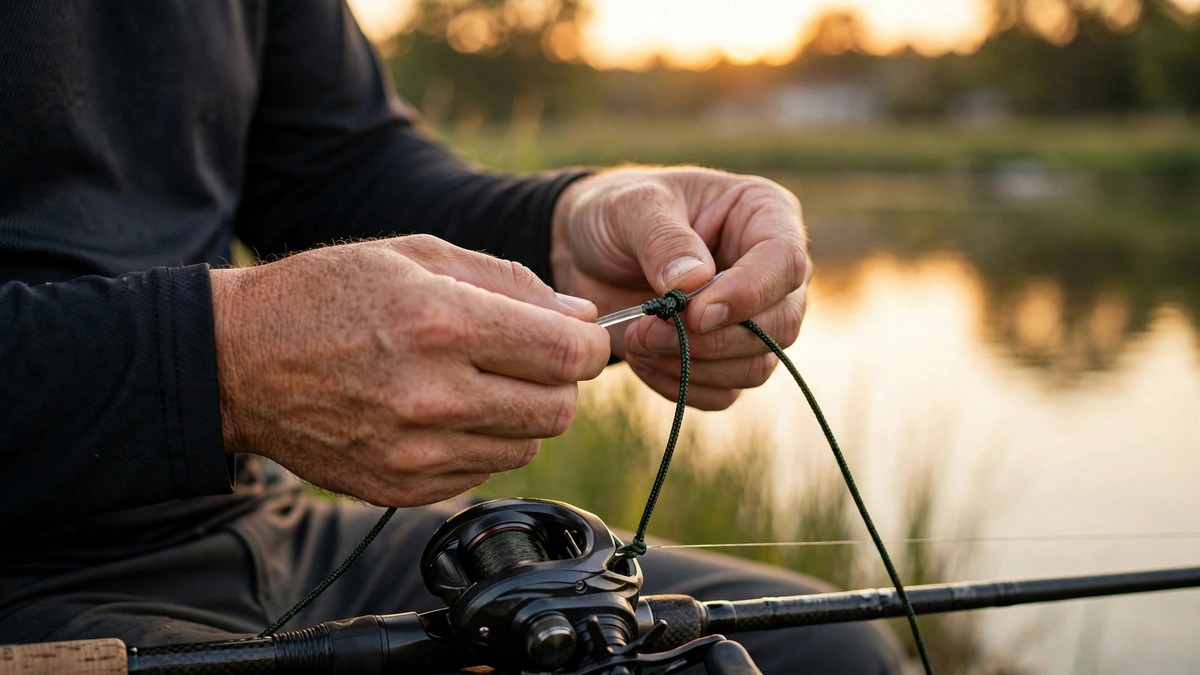
If you are still setting up the reel itself, start with my guide on how to spool a baitcaster reel first. A properly spooled reel with the right backing makes everything in this article work better.
When you DO need a leader
Tie one on when any of these are true:
Clear water and pressured fish
This is the big one. Braid is thin but opaque, and in clear water under bright sun, fish see it. On lakes that get hammered, bass learn to associate line with danger. A fluorocarbon leader is nearly invisible underwater, so the last few feet near your bait disappear. If I am fishing a clear reservoir or a pond that sees a dozen anglers a weekend, I always run a leader.
Abrasive cover: rock, docks, zebra mussels
Braid’s second weakness is abrasion. Those woven fibers are incredibly strong in a straight pull, but they fray when sawed across a sharp edge. Fluorocarbon is a single hard strand and takes abuse from rock, concrete pilings, and shell beds far better. The braid handles the long cast and the hookset; the leader handles the punishment near the business end.
Finesse and slow presentations
When you fish slowly, a fish gets a long look at your bait. Drop shots, shaky heads, and weightless soft plastics all sit in the strike zone long enough for a bass to inspect the whole package, line included. A leader earns its keep here.
Toothy or rough-mouthed species
Pike, musky, and bluefish will make short work of braid. A heavy fluorocarbon leader, sometimes up to 80 or 100 pound test, is standard practice. Here the leader is armor, not stealth.
When you can SKIP the leader
Leave the braid tied straight to the lure when any of these are true:
Frogging and punching heavy mats
The classic straight-braid situation. Walking a frog across matted vegetation or punching through hydrilla, you need every bit of pulling power, right now. A leader knot is a weak point you do not need, and under a mat, fish react rather than inspect. My breakdown of when to use frog baits for bass covers the technique in detail, and it is a straight-braid game.
Muddy or heavily stained water
If you cannot see your hand a foot underwater, the fish cannot see your line either. In muddy spring runoff or a wind-churned shallow flat, a leader buys you nothing. Tie direct and enjoy the sensitivity.
Reaction strikes
Burning a spinnerbait or ripping a lipless crank: when a fish has a split second to decide, line visibility barely registers. Plenty of anglers throw moving baits on straight braid all season.
Night fishing
At night, visibility is off the table entirely. Straight braid gives you maximum feel for bites you cannot see, and that is worth more than anything a leader offers after dark.
The decision matrix
When in doubt, run your situation through this table:
| Situation | Leader? | Why |
|---|---|---|
| Clear water, any technique | Yes | Braid is highly visible; pressured fish shy from it |
| Stained or muddy water | No | Fish cannot see the line anyway |
| Rock, docks, riprap, shell beds | Yes | Fluorocarbon resists abrasion far better than braid |
| Heavy vegetation mats (frogging, punching) | No | Maximum pulling power; fish react, do not inspect |
| Slow finesse presentations | Yes | Fish get a long look at the bait and line |
| Fast reaction baits (spinnerbait, lipless) | Optional | Strikes are instinctive; leader adds little |
| Topwater (walkers, poppers) | Mono leader or none | Fluorocarbon sinks and can drag the nose down; mono floats |
| Toothy fish (pike, musky, bluefish) | Yes, heavy | Armor against teeth, not stealth |
| Night fishing | No | Visibility is irrelevant; feel matters most |
Fluorocarbon vs monofilament leader
Once you decide to use a leader, the next choice is the material. For most baitcaster work, fluorocarbon wins, but monofilament has its place.
Fluorocarbon: the default
Fluoro is nearly invisible underwater, it sinks (which helps keep slack out of your line on the fall), and it is harder and more abrasion-resistant than mono. Those three traits cover nearly every reason you would tie on a leader in the first place. For jigs, Texas rigs, Carolina rigs, crankbaits, and jerkbaits, fluorocarbon is my leader material without much debate. If you are fishing jigs around cover, the techniques in how to jig fish pair naturally with a fluoro leader.
Monofilament: the specialist
Mono’s two advantages are stretch and buoyancy. The stretch forgives hard hooksets on treble-hooked baits, and the buoyancy matters for topwater: a fluorocarbon leader sinks and can pull the nose of a walking bait down, wrecking the action. For walkers and poppers, a short mono leader, or straight braid, fishes better. Mono is also cheaper, which matters if you retie often.
One honest con for fluorocarbon: it is stiffer, has more memory, and can be fussier to tie. Wet every fluoro knot thoroughly before cinching, and test it with a firm pull before you cast. A poorly seated fluoro knot is the number one cause of “my leader keeps breaking” complaints, and it is a knot problem, not a line problem. For a deeper dive, see baitcasting reel vs spinning reel and how to set up a baitcaster for bass fishing.
How long should your leader be?
For baitcasters, I run 2 to 4 feet, and leader length is more strategic here than on spinning gear. Here is why: that connection knot travels through your guides on every cast. You have two clean options.
Option 1: short leader, knot outside the tip. Tie on about 2 feet of leader. On the cast, the knot never enters the guides because it starts outside the rod tip. This is the simplest setup, and it is what I recommend if you are new to leaders.
Option 2: longer leader with a slim knot. Run 4 to 6 feet and let the knot pass through the guides. This only works well with a genuinely slim knot, which means the FG knot (more below). A long leader keeps the visible braid farther from the bait on the fall, which matters for jerkbaits and crankbaits. Check your guide inserts periodically for wear if you run this setup.
What I do not recommend: a long leader tied with a bulky knot. A double uni passing through micro guides feels like dragging a pebble through a straw. You will lose casting distance, and on a hard cast the knot can catch a guide and cost you a lure.
Matching leader pound test to your braid
The leader is almost always lighter than the braid, and that is by design. Braid’s thin diameter means 30 or 40 pound braid is roughly the diameter of 10 pound mono, so “lighter” leader still fishes fine. A practical starting framework for bass:
- 30 lb braid: 12 to 15 lb fluorocarbon leader for general bass fishing, jigs, Texas rigs
- 40 lb braid: 15 to 20 lb leader for heavier cover, bigger jigs, swim jigs
- 50 to 65 lb braid: 20 to 25 lb leader for flipping, or no leader at all for frogging
- 15 to 20 lb braid (finesse): 8 to 10 lb leader for shaky heads and light plastics
Keep the leader at or below the braid’s strength so that if something has to give, it is the cheaper, easier-to-retie leader. Size the leader to the cover and the hook too: punching heavy cover with a big hook wants a heavier leader than the braid number alone suggests. If you have not dialed in the spool itself, read how to spool a baitcaster and how to adjust your baitcasting reel first.
Braid-to-leader knots compared
Three knots cover essentially every braid-to-leader situation. I tie all three depending on the day, and here is the honest breakdown of each.
| Knot | Profile | Difficulty | Best use on a baitcaster |
|---|---|---|---|
| FG knot | Slimmest, nearly the diameter of the line itself | Hardest to learn; needs tension and practice | The gold standard when the knot must pass through guides. Long leaders, crankbaits, jerkbaits. |
| Alberto (modified Albright) | Slim, slightly larger than FG | Moderate; easy once you have the wrap rhythm | The best all-rounder. Slim enough for most guides, fast enough to tie on the water. |
| Double uni | Bulkiest of the three | Easiest; every angler should know it | Field repairs and short leaders where the knot stays outside the tip. Not ideal through micro guides. |
The FG knot: worth learning
The FG is the knot I tie when it matters most. Its wraps bite directly into the braid, creating a connection barely thicker than the line itself, and it flies through guides like it is not there. The tradeoff is real: it is fiddly to learn and wants steady tension while you wrap. Practice at home before you need it on the water.
The Alberto: my daily driver
If the FG is the race car, the Alberto is the pickup truck. Wrap the leader around a doubled loop of braid, typically 7 wraps up and 7 back, wet it, and cinch. It is slim enough for standard guides, strong enough that the leader breaks before the knot does, and genuinely tieable in a rocking boat. When someone asks me for one knot to learn first, this is the one.
The double uni: the field repair
Two uni knots pulled together. Everybody should know it because it joins any two lines in under a minute. Its weakness on a baitcaster is bulk: that lump announces itself through every guide. Use it for short leaders where the knot never enters the rod, or as a get-you-through-the-day repair, then retie an Alberto or FG that evening.
Whatever knot you choose, two rules are non-negotiable: wet the knot before cinching (fluorocarbon especially needs it to seat without heat damage), and test every knot with a hard pull before the first cast. A knot you do not trust will cost you a fish exactly when it matters. If knots and backlashes are both giving you trouble, my backlash removal guide and baitcaster tips for beginners will sort out the casting side. For authoritative knot illustrations, the IGFA maintains excellent knot resources, and Take Me Fishing has beginner-friendly line basics.
A quick gear note: not all fluorocarbon marketed as “leader material” is equal. Stiffer, abrasion-formulated leader spools behave better than limp main-line fluoro for this job. If you buy one spool, make it a dedicated leader material in 15-pound test, which covers most bass situations. Check current Seaguar leader options on Amazon.
Frequently asked questions
Can you tie braid directly to a lure on a baitcaster?
Yes. Tie a Palomar knot, which holds extremely well in braid, and fish with confidence when the situation calls for straight braid: heavy cover, muddy water, night fishing, or frogging. Just know you are trading stealth and abrasion resistance for sensitivity and power.
What is the best knot for braid to fluorocarbon leader?
The FG knot is the best performer: slimmest profile and excellent strength, ideal for baitcasters because the knot passes through the guides on every cast. The Alberto is the best balance of strength and ease, and the double uni is the easiest to learn.
How long should a leader be on a baitcaster?
Two to 4 feet covers most situations. Use a shorter leader (around 2 feet) with bulkier knots so the knot stays outside the rod tip, or a longer leader (4 to 6 feet) with a slim FG knot that passes through the guides cleanly.
Does braid color matter to fish?
In clear water, it can. Braid is far more visible underwater than fluorocarbon, and pressured fish may shy from it. High-visibility colors like yellow are great for detecting bites but worse for stealth. A clear leader solves the problem without giving up bright braid’s bite-detection advantage.
Should I use a leader with braid for frog fishing?
No. Frogging is a straight-braid technique. You need maximum pulling power to drag bass out of matted vegetation, the fish are reacting rather than inspecting, and a leader knot is just a weak point you do not need. Spool 50 to 65 pound braid and tie direct.
Can I use straight braid for crankbaits?
You can, but many crankbait anglers prefer a fluorocarbon leader or straight fluorocarbon. Braid has no stretch, so it can rip treble hooks free on the hookset, and crankbaits are often fished in clearer water where stealth helps. A 3 to 4 foot fluoro leader on braid gives you casting distance plus forgiveness at the business end. The notes in snaps for crankbaits pair well with this setup.
Affiliate disclosure: As an Amazon Associate, baitcastingreelz.com earns from qualifying purchases made through links on this page, at no extra cost to you. Line recommendations are based on on-the-water practicality, not commissions. If you are choosing your first baitcasting setup, see best baitcasting reel for beginners and best baitcasting reel for bass.