Reel Review · 2026
Shimano SLX A 150 Review: Still the $100 Baitcaster to Beat?
Should you buy the Shimano SLX A 150? Yes, if you want a $100 baitcaster that fishes like a $200 one: the HAGANE aluminum body doesn’t flex on hooksets, the externally adjustable SVS Infinity brake is easy to tune, and it weighs just 6.9 oz. Skip it if you fish heavy cover, where its 12 lb drag runs out, or if you want the simplest possible beginner brake. This review covers the base SLX A 150 (not the DC or BFS), with verified specs, real owner gripes, and a direct comparison against the Daiwa Fuego CT and Abu Garcia Revo X.
Affiliate disclosure: As an Amazon Associate, baitcastingreelz.com earns from qualifying purchases made through links on this page, at no extra cost to you. Rankings are technique-led and independent of commissions.
Ask a room of experienced bass anglers which reel they’d hand a beginner with a $100 bill, and the SLX name comes up more than any other. It has real competition now from the Daiwa Fuego CT and Abu Garcia Revo X, and honest owners have a few gripes worth knowing. Below: verified specs, how the reel behaves in the hand and on the cast, the real complaints, how to set the brake, and which $100 reel actually wins.
Shimano SLX A 150: key specs
| Spec | SLX A 150 (base) |
|---|---|
| Gear ratios | 6.3:1 (150), 7.2:1 (150HG), 8.2:1 (150XG) |
| Bearings | 3+1 S A-RB (3 ball + 1 roller) |
| Weight | 6.9 oz |
| Max drag | 12 lb |
| Mono capacity | 10 lb / 120 yd · 12 lb / 110 yd · 14 lb / 90 yd |
| Braid capacity (PowerPro) | 20 lb / 150 yd · 30 lb / 135 yd · 40 lb / 105 yd |
| Braking | SVS Infinity centrifugal, externally adjustable dial |
| Body | HAGANE cold-forged aluminum frame and sideplates |
| Gears | Brass gearing with X-Ship support |
| Spool | S3D balanced spool with Silent Tune |
| Retrieve | Right (150) and left (151, 151HG, 151XG) available |
Specs verified against Shimano’s official product data, Tackle Warehouse’s SLX DC spec sheet (7.6 oz, 4+1 bearings), and Anglers Warehouse’s SLX listing (SVS Infinity with external adjustment, roughly 135 yards of 30 lb braid). Note: the SLX A is the generation with the external brake dial. The original 2018 SLX had internal brake pins that required popping the sideplate, so ignore old reviews complaining about that.
Which Shimano SLX model should you buy?
Four reels share the SLX name, and this confusion is the biggest trap in this buying decision. Here is the complete family breakdown, the section most SLX reviews skip.
| Model | Price tier | Braking system | Key difference | Buy it for |
|---|---|---|---|---|
| SLX A 150 (base) | ~$100 | SVS Infinity centrifugal, external dial | 6.9 oz, 12 lb drag | All-round bass fishing, first serious reel |
| SLX XT A 150 | ~$130 | SVS Infinity centrifugal, external dial | S3D spool, Cross Carbon drag | Near-Curado refinement on the same platform |
| SLX DC 150 | ~$190 | I-DC4 digital braking | 7.6 oz, 4 settings | Maximum backlash insurance, windy conditions |
| SLX BFS XG | ~$200 | FTB finesse brake | Shallow finesse spool | Light lures and BFS techniques only |
Takeaway: if the price is around $100, it’s the base SLX A and this review applies. Around $190 with a digital “DC” label means a different reel entirely, and the BFS is a finesse specialist, not an upgrade. Buy the base SLX A for general bass work, step up to the DC for backlash insurance, or read our Daiwa Tatula vs Shimano Curado comparison if your budget reaches the next tier.
Single-product review · $100 baitcaster
Shimano SLX A 150
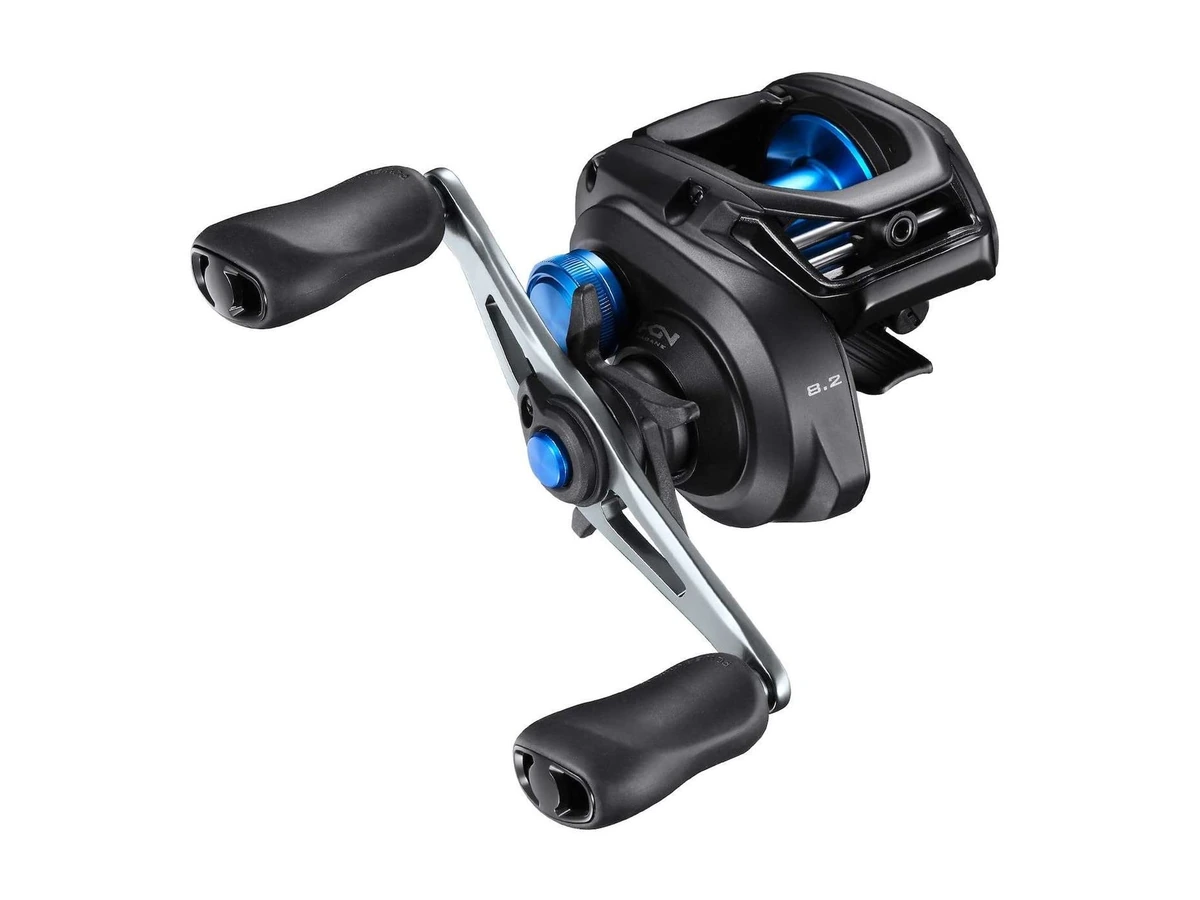
The first thing you notice is how small it feels: noticeably more compact than most reels in this class, and at 6.9 ounces it sits deep in the palm on a 7-foot medium-heavy rod. Anglers with smaller hands keep recommending it over bulkier $100 options; it disappears on the rod during a long day of casting.
On the cast, the S3D balanced spool gives smooth startup and low vibration, with no surge when a light lure decelerates. This is where most owners report their “casts like a $200 reel” moment, and it’s real: with 30 lb braid or 12 lb mono, the distance is excellent for the money.
The SVS Infinity brake is the control system that holds it together, and the external dial is the key change from the original SLX: no sideplate removal, just turn the dial for a light lure into the wind and back it off for a heavier one. Centrifugal brakes bite hardest early in the cast and release as the spool slows, which suits overhand and sidearm casts with mid-weight lures like jigs, spinnerbaits, and Texas rigs.
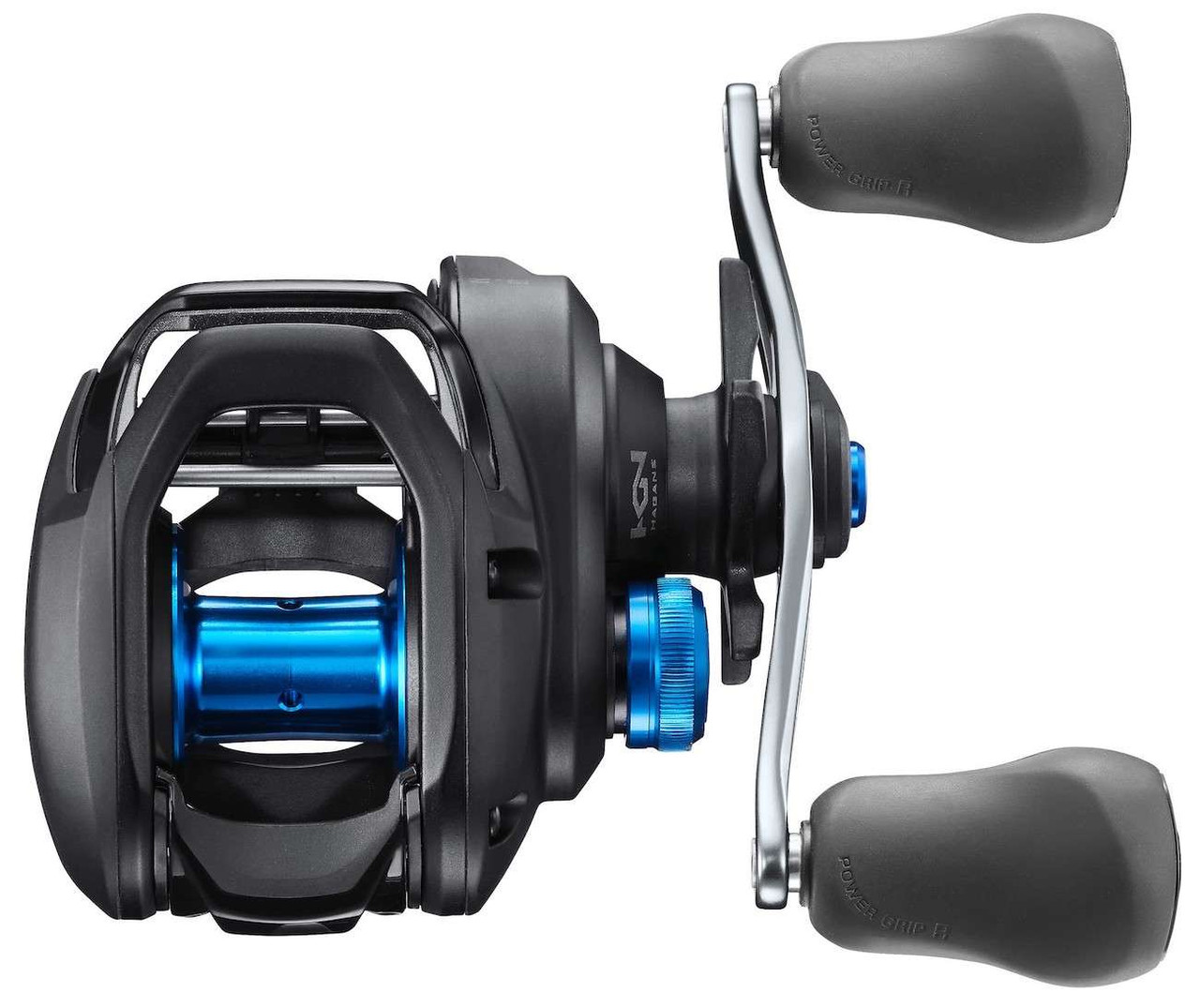
On the retrieve, the HAGANE aluminum frame is the quiet advantage. Cheap graphite frames bend slightly on hard hooksets and eat energy; the SLX doesn’t flex, so hooksets feel crisp and every handle turn converts to line retrieved. The X-Ship-supported gearing feels tight and connected, which is why owners keep this reel in the rotation for years instead of retiring it to backup duty.
The drag is smooth but modest at 12 lb. For jigs, spinnerbaits, crankbaits, and light Texas rigs in open water, it slips evenly without the sticky surge of cheap reels. It is not a heavy-cover drag: frogging through mats or punching thick vegetation exposes the limit, and this is where the Abu Garcia Revo X (18 lb) posts a real advantage.
Note: the button above is for the right-hand SLX A 150. The left-hand SLX A 151 (and 151HG / 151XG) is a separate listing; verify handedness and model number before ordering.
What does the SLX A 150 do best?
The frame is the headline. A cold-forged aluminum body at this price is why the SLX beats graphite-frame rivals on hookset feel and long-term tightness. TackleTour’s $99 roundup measured this class head to head years ago; the SLX’s rigidity still stands out now.
The external brake dial fixed the old reel’s worst flaw. Being able to add braking for a light lure into the wind and back it off for a 3/4 oz spinnerbait, mid-session, on the water, is exactly the feedback loop a developing caster needs.
Three ratios, one platform. The 6.3:1 is the all-rounder for crankbaits, the 7.2:1 is the sweet spot for jigs and Texas rigs, and the 8.2:1 is for flipping and pitching. Buy the 7.2:1 if you can only have one. Our gear ratios explained guide breaks down when each speed wins.
Takeaway: the SLX wins on frame, braking, and longevity, but not on drag power or beginner forgiveness. That’s exactly where the rivals fight back, as you’ll see in our Shimano SLX vs Daiwa Fuego CT head-to-head.
What do owners complain about?
Twelve pounds of drag is a ceiling. The Fuego CT posts 13.2 lb and the Revo X posts 18 lb. For open-water bass, 12 lb is fine. For heavy cover, frogging, and punching, it isn’t, and the aluminum frame can’t make up for drag washers that aren’t there.
Plain knobs and a workmanlike finish. The handle knobs are functional but basic, and the matte black body shows scuffs. It looks like a tool, which it is, but it won’t turn heads next to a Lew’s.
Brake pins need occasional cleaning. Centrifugal brake pins collect grime, and several owners report the braking feel getting inconsistent until the pins get a wipe-down. A two-minute job, but one that magnetic reels never ask of you.
Gears can lose their silkiness. After a season or two of heavy use, the gears can feel less smooth than new. Usually this is a maintenance story, not a defect story: a proper cleaning with fresh grease brings them back. But a $100 reel doesn’t get the MicroModule gear cutting of the Curado, and it shows over time.
Takeaway: the common complaints are modest and honest: 12 lb of drag, plain knobs, and a brake system that asks for a learning session and the occasional wipe-down. None is a dealbreaker for typical bass fishing, but all matter for heavy cover. Avoid the classic beginner baitcaster mistakes that make any reel feel worse than it is.
How do you set up the SVS Infinity brake?
Takeaway: start with the dial at 4 and mono, then back the brake off one click at a time as your thumb learns. Most anglers settle around 2 or 3 for everyday lures.
Spool with 12 or 14 lb monofilament first, not braid; mono is more forgiving while thumb control develops. Set the spool tension knob so your lure falls slowly and stops when it hits the ground, then set the SVS Infinity dial around 4. Make easy overhead casts and let the centrifugal brake do the work early in the cast while your thumb learns to feather the spool at the end. As control improves, dial the brake down one click at a time. Centrifugal brakes work hardest at the start of the cast, so a smooth acceleration matters more than raw power. If you’re still getting overruns, our guide to preventing baitcaster backlash covers the mechanics no brake setting can fix.
Shimano SLX vs Daiwa Fuego CT vs Abu Garcia Revo X: which $100 reel wins?
This is the comparison that actually matters at $100, because these three are the default shortlist.
| Spec | Shimano SLX A 150 | Daiwa Fuego CT | Abu Garcia Revo X |
|---|---|---|---|
| Gear ratios | 6.3:1 / 7.2:1 / 8.2:1 | 6.3:1 / 7.3:1 / 8.1:1 | 6.6:1 / 7.3:1 |
| Weight | 6.9 oz | 7.6 oz | 7.6 oz |
| Bearings | 4+1 | 7+1 | 7+1 |
| Max drag | 12 lb | 13.2 lb | 18 lb |
| Mono capacity (12 lb) | 110 yd | 150 yd | 145 yd |
| Braking | SVS Infinity centrifugal, external dial | Magforce-Z magnetic, external dial | MagTrax magnetic, external dial |
| Frame | HAGANE aluminum | Aluminum frame | X-Craftic alloy frame |
| Price tier | ~$100 | ~$100 | ~$100 |
What most SLX reviews get wrong: they crown the SLX on reputation alone. The SLX is the lightest and most compact, with the most rigid frame, which shows up on hooksets and over seasons of use. The Fuego CT is the more forgiving learner’s reel with an easier-to-dial magnetic brake. The Revo X is the power pick: 18 lb of drag makes it the best of the three for heavy cover and frogs.
My read: pick the SLX if you want the smallest, most refined-feeling reel and plan to fish it for years. Pick the Fuego CT if you’re newer to baitcasters and want the easiest brake to learn. Pick the Revo X if you fish heavy cover and want maximum drag for the money.
Takeaway: the SLX wins on weight, compactness, and frame rigidity; the Fuego CT wins on beginner forgiveness; the Revo X wins on drag power. Pick based on your fishing, not on brand loyalty. For the full two-reel deep dive, read our Shimano SLX vs Daiwa Fuego CT comparison.
Should you buy the Shimano SLX A 150?
Takeaway: buy the SLX A 150 for general bass fishing you want to keep doing for years; look elsewhere for heavy cover, saltwater, or the absolute cheapest first reel.
Buy it if: you want your first serious baitcaster, one you’ll still fish years from now; you fish jigs, spinnerbaits, Texas rigs, and crankbaits in light to medium cover; you have smaller hands and want the most compact reel in the class; you want to standardize on one platform and buy multiple ratios later.
Skip it if: you fish heavy cover, mats, or thick timber regularly, where the 12 lb drag is the limiter (see our best baitcasting reels for flipping and pitching for power-oriented options); you want the absolute easiest brake to learn as a first-timer (look at the Fuego CT in our beginner roundup); your budget tops out under $60 (see our best baitcasting reels under $50); you fish saltwater regularly; or you’re deciding between the SLX and the cheaper Abu Garcia, in which case read our Abu Garcia Black Max vs Shimano SLX head-to-head.
Shimano SLX A 150 FAQs
Is this review about the base SLX A 150 or the SLX DC / SLX BFS?
The base SLX A 150, the roughly $100 reel with SVS Infinity centrifugal braking. The SLX DC 150 adds digital I-DC4 braking at around $190, and the SLX BFS is the finesse model at around $200. They share a name, not a price or a brake system, so always check the model number on the listing.
Is the Shimano SLX good for beginners?
Yes, it’s one of the most recommended first baitcasters in existence. The externally adjustable brake is forgiving, the compact body is easy to palm, and the rigid frame means the reel still fishes well years later instead of becoming a disposable trainer. That said, a magnetic-brake reel like the Daiwa Fuego CT is a slightly easier first brake to learn.
What is the difference between the Shimano SLX A 150 and the SLX DC 150?
The braking system and the price. The base SLX A 150 uses centrifugal SVS Infinity brakes with an external dial at around $100. The SLX DC 150 uses digital I-DC4 braking that automatically manages the spool during the cast, at around $190 and 7.6 oz. Same HAGANE frame DNA, different control systems.
Does the Shimano SLX need batteries?
The base SLX A 150 needs no battery at all; it is a fully mechanical centrifugal-brake reel. Only the SLX DC uses electronics: its I-DC4 digital braking system generates its control power from the spool’s rotation during the cast.
Can you use the Shimano SLX in saltwater?
Light, occasional inshore use is possible with thorough cleaning afterward, but the SLX A 150 is built as a freshwater reel. If saltwater is your main game, spend more on a corrosion-protected reel instead.
What gear ratio should I get: SLX 150, 150HG, or 150XG?
The 150 (6.3:1) is the all-rounder for crankbaits and slow rollers. The 150HG (7.2:1) is the sweet spot for jigs, Texas rigs, and spinnerbaits, and it’s the one I’d buy if I could only have one. The 150XG (8.2:1) is for flipping, pitching, and fast line pickup. Add 1 to the model number for the left-hand versions (151, 151HG, 151XG).
Shimano SLX vs Daiwa Fuego CT: which is better?
The SLX is lighter (6.9 vs 7.6 oz), more compact, and has the more rigid frame. The Fuego CT has an easier-to-learn magnetic brake, more line capacity, and a bit more drag. Brake tinkerers and beginners lean Fuego; long-haul owners and small-handed anglers lean SLX. Read our full Shimano SLX vs Daiwa Fuego CT head-to-head for the complete breakdown.
Does the SLX A 150 come in left-hand retrieve?
Yes. Left-hand models are the SLX A 151 (6.3:1), 151HG (7.2:1), and 151XG (8.2:1). The Amazon button in this review links to the right-hand 150; verify the hand on the listing. Not sure which hand to crank with? See our left hand vs right hand baitcaster guide.
What line should I put on an SLX A 150?
For a beginner, 12 to 14 lb monofilament, which is most forgiving while thumb control develops. Once comfortable, 30 lb braid is the popular choice at about 135 yards capacity, with a fluorocarbon leader for clear water. For the full trade-offs, read our braid vs fluorocarbon on a baitcaster guide.
Is the Shimano SLX A 150 worth it?
The SLX A 150 is still the $100 baitcaster to beat, but it no longer wins by default. The frame, the spool, and the external brake dial are genuinely excellent at this price, and as a reel you’ll fish for years rather than outgrow, nothing in the class is a safer buy. The Fuego CT is the easier first reel and the Revo X is the stronger heavy-cover reel. Buy the 7.2:1 as your all-rounder, learn the centrifugal brake for a session or two, maintain it once a season, and this reel will outfish its price tag for a long time.
© baitcastingreelz.com · Affiliate disclosure: As an Amazon Associate, baitcastingreelz.com earns from qualifying purchases. This does not change the editorial selection criteria. Editorial note: This review covers the base Shimano SLX A 150 (SVS Infinity, ~$100). Specifications, availability and prices change, so verify the model number and specs on the product listing before ordering. “Buy From Amazon” buttons take you to Amazon; product availability, specifications and prices can change.