How to Set the Drag on a Baitcasting Reel
To set the drag on a baitcasting reel, turn the star wheel next to the handle until the drag slips at 25 to 33 percent of your line’s breaking strength. On 12 pound test, that means line should start pulling off the spool at 3 to 4 pounds of pressure. On 20 pound test, it is 5 to 6.5 pounds. Turn the star forward to tighten it, and back toward you to loosen it. Set it with a scale at home, then check it with a pull test every trip.
But in my experience, drag is the setting anglers get wrong most often, because nobody ever showed them the number. Most people guess. They crank the star down until the line feels tight enough, usually far above what the line can survive on a hard run. Others fish it so loose that the hook never drives home on the hookset. Both mistakes cost fish, and both take thirty seconds to fix.
What the Drag Actually Does
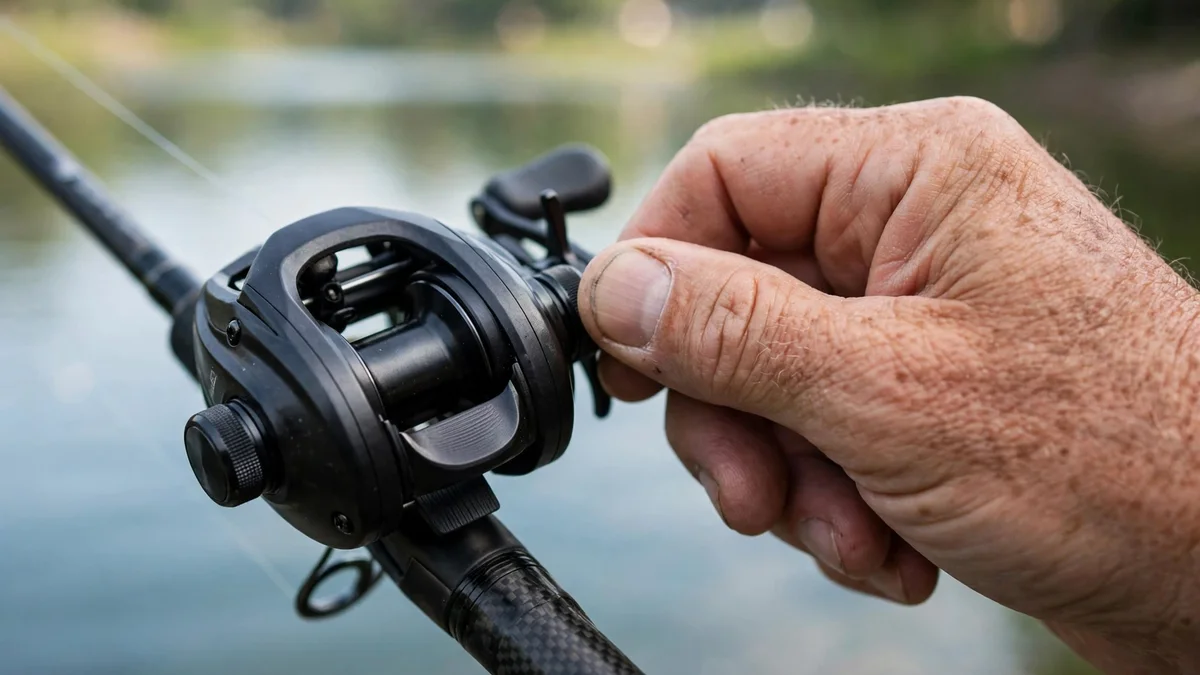
Your drag is a clutch. A stack of washers sits on the spool shaft, and the star wheel squeezes that stack together. Our guide to every part of the reel shows where every washer and gear lives. When a fish pulls harder than the pressure you have set, the washers slip and the spool pays out line in a controlled way. That slip is the whole point: it lets a strong fish run without snapping your line or tearing the hook free. A fish also pulls far less than it weighs. A five pound bass surging at the boat might put only a pound or two of real pressure on your line. The rod bends and the line stretches to absorb the rest, and the drag should slip before any of them reach their limit.
The Rule: 25 to 33 Percent of Your Weakest Link
The standard rule is simple: set your drag to 25 to 33 percent of the breaking strength of your line. On 15 pound test, the drag should slip at roughly 4 to 5 pounds. The margin exists because knots weaken line, guide friction adds load, and a surging fish adds more.
Set the drag against the weakest link in your setup, not the line printed on the big spool. If you run 30 pound braid with a 12 pound fluorocarbon leader, your setting belongs to the leader and its knot, not the braid. The braid will never be the thing that breaks. The leader will. So that setup gets 3 to 4 pounds of drag, the same as straight 12 pound line. If you are unsure which line class your fishing falls into, our guide on which line class fits your fishing walks through the choices.
Where in the range should you sit? Start at the low end, around 25 percent, for light line, light wire hooks, and open water. Move toward 33 percent for heavy line, strong hooks, and cover a fish can reach quickly. If in doubt, start low: a slightly loose drag loses you very little, while a tight drag loses you the fish and the lure.
How to Set the Drag With a Scale, Step by Step
A small spring scale or luggage scale removes all the guessing. Do it once at home for each reel you own. It belongs in any full bass setup, and takes about a minute per reel.
- Rig the rod fully. Run the line through every guide. Measuring straight off the reel reads high, because it skips the friction and flex the fish actually feels.
- Attach the scale. Tie your line to the scale hook, or clip the scale to a loop tied in the line. Have a partner hold it, or hook it to something solid.
- Load the rod. Hold the rod at about 45 degrees and pull back slowly so it bends the way it does in a fight. Keep pulling smoothly until the drag starts to slip.
- Read the number at the moment of slip. That reading is your drag setting. Not the peak after, not the average. The weight showing when the line first moves is the number that counts.
- Adjust in small turns and retest. Turn the star forward a click or two to add drag, or back toward you to reduce it. Small turns make a real difference on a baitcaster. Retest after every adjustment until the scale reads your target.
- Mark the spot. Note where the star sits, or mark it with a tiny dot of paint or tape, so you can find the same setting in seconds after loosening the drag for storage.
No Scale? The Pull Test and the Water Bottle Method
Most of us set drag at the ramp, where nobody carries a scale.
The pull test
With the line through the guides, hold the rod at about 45 degrees and pull line off the tip by hand in one steady motion. You are feeling for three things: firm, steady effort, like pulling open a heavy door; a smooth slip, with no jerking or sticking at the start; and slip that begins well before you feel the line itself stretch. If mono or fluoro stretches in your hand, the drag is too tight. If the rod fully doubles over on a hard pull and nothing slips, back the star off.
The water bottle method
For a number without a scale, use water. A filled 1 litre bottle weighs about 2.2 pounds, a half gallon jug about 4.2 pounds, a full gallon about 8.3 pounds. Tie your line to the handle, rest the bottle on the ground, and lift slowly with the rod at 45 degrees. The drag should start to slip just as the bottle leaves the ground. If it lifts cleanly and hangs there, your drag is heavier than that weight. If it slips long before the lift, you are under it.
Baitcaster Drag Settings Chart
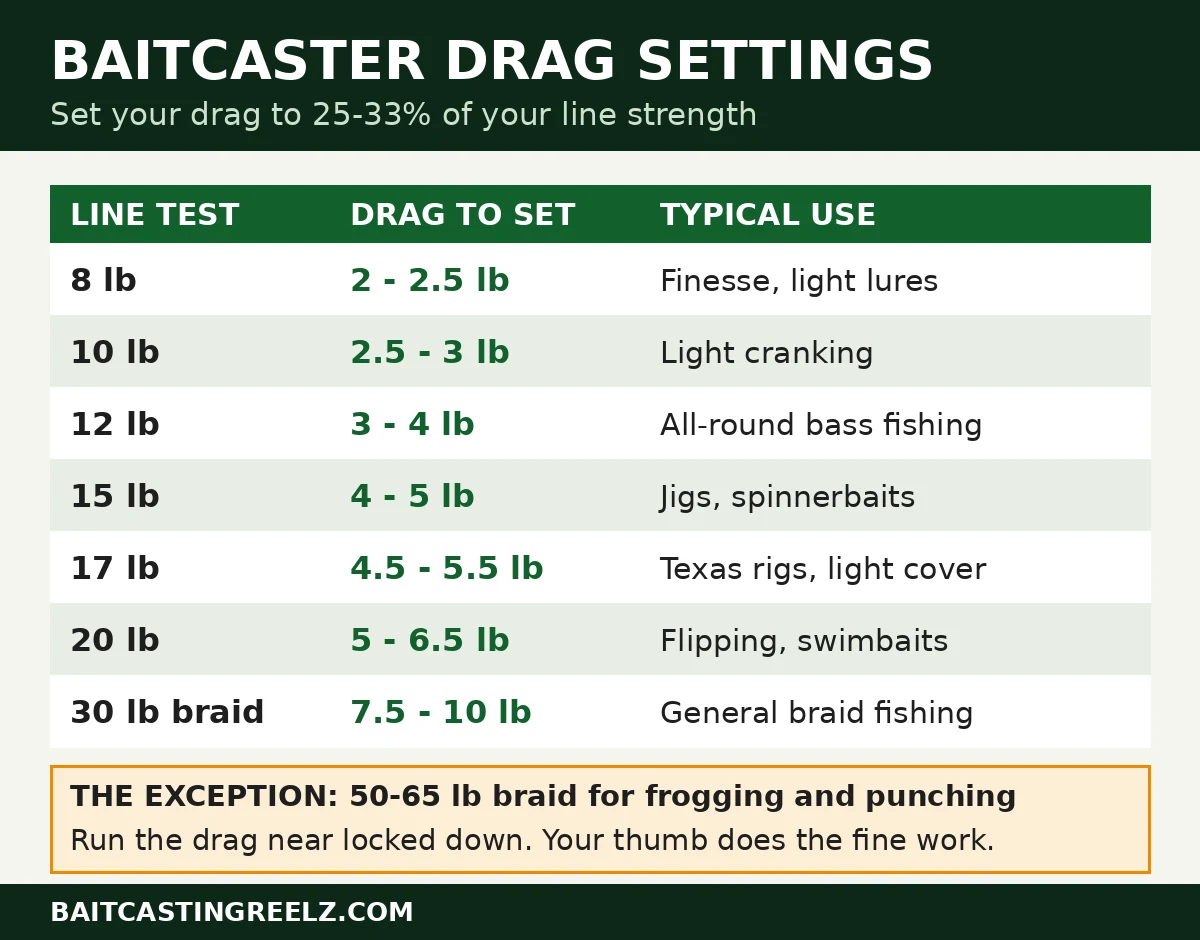
Here is the rule worked out for the line weights bass anglers actually fish.
| Line test | Drag to set | Typical use |
|---|---|---|
| 8 lb | 2–2.5 lb | Finesse, light lures |
| 10 lb | 2.5–3 lb | Light cranking |
| 12 lb | 3–4 lb | All-round bass fishing |
| 15 lb | 4–5 lb | Jigs, spinnerbaits |
| 17 lb | 4.5–5.5 lb | Texas rigs, light cover |
| 20 lb | 5–6.5 lb | Flipping, swimbaits |
| 30 lb braid | 7.5–10 lb | General braid fishing |
One warning: your reel has a maximum drag rating, often in the low to mid teens of pounds on bass reels. If your target is higher than the reel can produce, the reel is the limit, and that is fine for bass. Max drag is worth a glance when comparing reels in our roundup of the the top picks. You do not need the biggest number, just a drag that is smooth at the settings in this chart.
The Exception: Heavy Braid in Thick Cover
One situation breaks the rule. When you frog or punch mats with 50 to 65 pound braid, anglers run the drag near locked down, and they are right to. The rule exists to protect your line. But 25 percent of 65 pound braid is over 16 pounds of drag, more than most bass reels even make, and far more force than a bass can apply. The real risks in heavy cover are a weak hookset that never drives the frog hooks home, and a fish that needs only two feet of line to bury itself in the mat.
So tighten the star down hard and let your thumb do the fine work, feathering the spool when a fish surges at the boat instead of hunting for the star mid-fight. When that reel goes to open water or lighter line, go back to the chart.
Adjusting the Drag During a Fight
You will hear two opposite pieces of advice: never touch the drag in a fight, and adjust it freely. The truth is narrower: backing off is almost always safe, and tightening mid-fight is where lines die.
- Fish making a long run: back the star off a click or two, or let the set drag do its job. Never try to stop the run by tightening.
- Fish surging at the boat: this is where most break-offs happen. Keep the rod up and let the drag slip. If you need a touch more control, feather the spool with your thumb rather than reaching for the star.
- Fish running at you: no drag change. Reel fast, keep the line tight.
- After the fight: return the drag to your marked setting before the next cast. Most mystery break-offs and missed hooksets happen on the cast after a fight, on a drag nobody reset.
When the Drag Feels Wrong: A Quick Diagnostic
A drag that will not hold a setting, or will not slip smoothly, is a different problem. First confirm the star is actually where you think it is. The drag is one of three separate controls on the reel, and our guide on the three reel controls covers all three. If the setting is right and the drag still misbehaves, run through these three, in order:
- It slips on the hookset. Either the setting is under the floor for your line, or nobody reset it after the last fight.
- It slips even with the star fully tight. On braid, the whole line stack may be spinning on the spool, spooled with no backing to grip the arbor. If it happens on mono too, the washers are worn out.
- It feels jerky or sticky. Dirty, dry, or worn washers. A sticky drag is worse than a loose one, because the startup surge is exactly when lines break.
Our diagnostic for a drag that slips works through the causes in order.
The Storage Habit That Keeps Drags Smooth
When you put a reel away, back the star drag off. Constant pressure compresses the drag washers while the reel sits, and compressed washers give you a drag that is weaker at the top end and less smooth everywhere. It is the cheapest maintenance there is: five seconds, no tools. It is also why the pull check matters before every trip, and why the marked star position matters: it gets you back to your number in seconds. Once a season, pair it with a proper clean from our guide on cleaning and maintaining your reel.
Frequently Asked Questions
How tight should the drag be on a baitcasting reel?
Set it to 25 to 33 percent of the breaking strength of your weakest line. On 12 pound test, that is 3 to 4 pounds of pull before the line slips. On 20 pound test, it is 5 to 6.5 pounds. Tight enough to drive the hook home and move a fish, loose enough to give line on a hard run before anything gives up.
How do I set the drag without a scale?
Use the pull test or water. For the pull test, run the line through the guides, hold the rod at about 45 degrees, and pull line off the tip by hand. It should slip with firm, steady effort, smoothly, before the line stretches. For a real number, lift a filled water bottle with the rod: 1 litre weighs about 2.2 pounds, a half gallon jug about 4.2 pounds, a gallon about 8.3 pounds. The drag should start slipping just as the bottle leaves the ground.
Should I adjust the drag while fighting a fish?
Only backward, and only a little. Backing the star off one or two small clicks while a fish runs is safe. Tightening the drag during a run is how lines snap. On a baitcaster your finer tool is your thumb: feather the spool instead of reaching for the star.
Why does my drag slip when I set the hook?
Work through it in order. First, the setting is probably under the 25 percent floor for your line, or nobody reset it after the last fight. Second, if the star is tight and line still peels off, braid may be spinning on the spool, spooled without backing or a wrap of tape to grip it. Third, if the slip feels jerky, the drag washers are dirty or worn. Our guide to a slipping drag covers each cause and fix in order.
Is the star drag the same as the spool tension knob?
No. The star drag sets how much force it takes to pull line off the reel while fighting a fish. The spool tension knob, the cap on the side of the reel, controls how freely the spool spins during the cast, which is about preventing backlash. Different jobs entirely, and setting one never fixes the other.
Should I loosen the drag when I store the reel?
Yes. Back the star off before the reel goes away, even for a few weeks. Constant pressure compresses the washers, and compressed washers give a weaker, less smooth drag over time. Before your next trip, run the pull check and turn the star back to your marked setting.
The 30-Second Version
It all reduces to a short routine. Know your weakest line. Set the drag to 25 to 33 percent of it with a scale, and mark the star. Check it with a pull test every trip. Leave it alone during the fight, except a click or two backward. Break the rule only for heavy braid in heavy cover. Back it off when the reel goes away. New to the reel? Run the drag step as part of the full setup routine, then put the setting to work with our guide on the basic cast. A drag set by number, not by hope, is the difference between the fish that got away and the one in the photo.