Tackle Fundamentals · US Guide
Baitcasting Reel vs Spinning Reel: Which One Should You Fish?
The baitcasting reel vs spinning reel debate has a simple resolution: spinning reels win for light lures, finesse presentations and the shortest learning curve, while baitcasting reels win for casting precision, heavier line and power techniques around cover. This guide compares how each reel works, where each one shines, and how to choose, including why most serious anglers end up owning both.
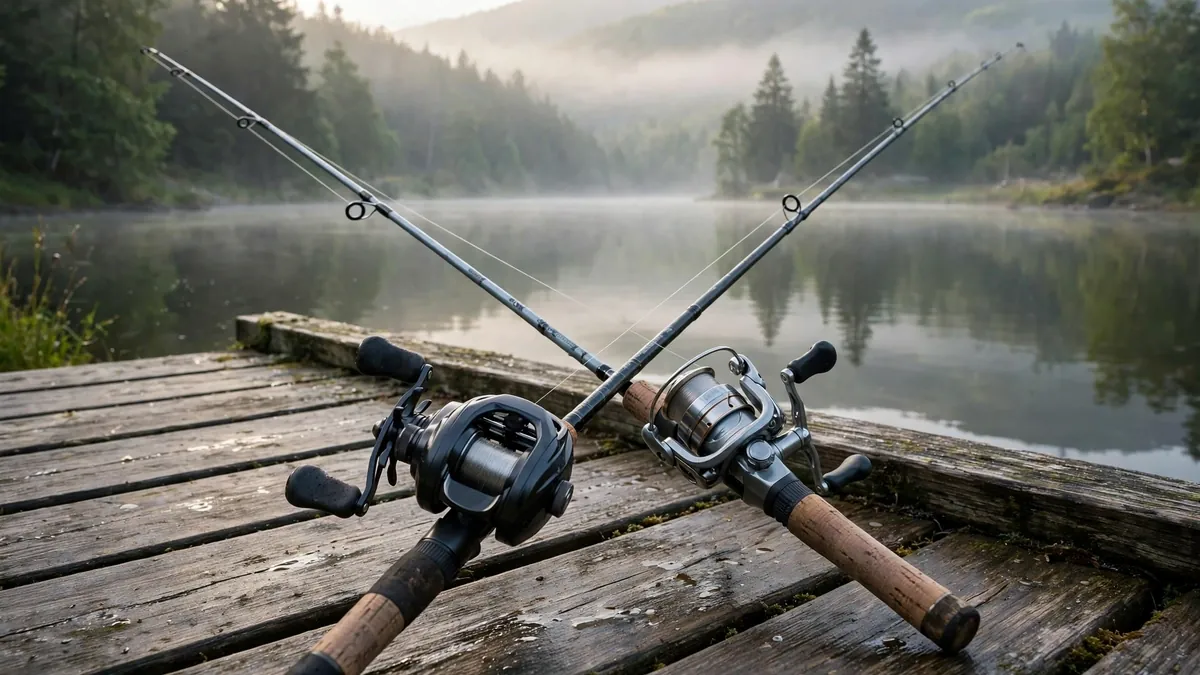
The quick answer
Choose a baitcasting reel for medium-to-heavy lures, pinpoint casting accuracy, heavier line, and power techniques like flipping, pitching, frogging and deep cranking.
Choose both if you fish varied water, most experienced anglers carry one of each because the two reels cover each other’s weaknesses perfectly.
How the two reel styles work
Spinning reel
Line hangs below the rod on a fixed spool. On the cast, line peels off the spool’s lip with almost no resistance, nothing spins, nothing can overrun. A bail arm wraps line back on during the retrieve while the levelwind-like oscillation lays it evenly. Because the line leaves freely, spinning reels cast light lures farther and tangle less. The trade-off: line twist accumulates over time, heavy line is harder to manage on the fixed spool, and you have less direct control over the line in flight.
Baitcasting reel
The spool sits atop the rod and rotates during the cast, feeding line directly in line with the rod guides. Your thumb rides the spool, controlling speed, feathering distance and stopping overrun. This direct connection is the source of the baitcaster’s precision and power: heavier line behaves beautifully, casting accuracy is superb, and winching fish from cover feels authoritative. The trade-off is the learning curve: if the spool outruns the lure, you get the infamous backlash (bird’s nest). Braking systems, magnetic, centrifugal, dual and digital, exist to manage exactly this risk.
Casting: simplicity versus spool control
With a spinning reel, casting is nearly foolproof: open the bail, hold the line with a finger, swing, release. Light lures fly well, wind is manageable, and beginners catch fish on day one. With a baitcaster, casting is a skill: spool tension, brake settings and thumb timing all interact, and the first sessions demand practice (see our our beginner guide).
But that skill buys something real. A tuned baitcaster places a 1/2 oz jig beside a dock piling with a precision spinning gear struggles to match, and it does it while handling 50 lb braid without complaint. Accuracy and line authority are the baitcaster’s casting dividends, paid for with practice.
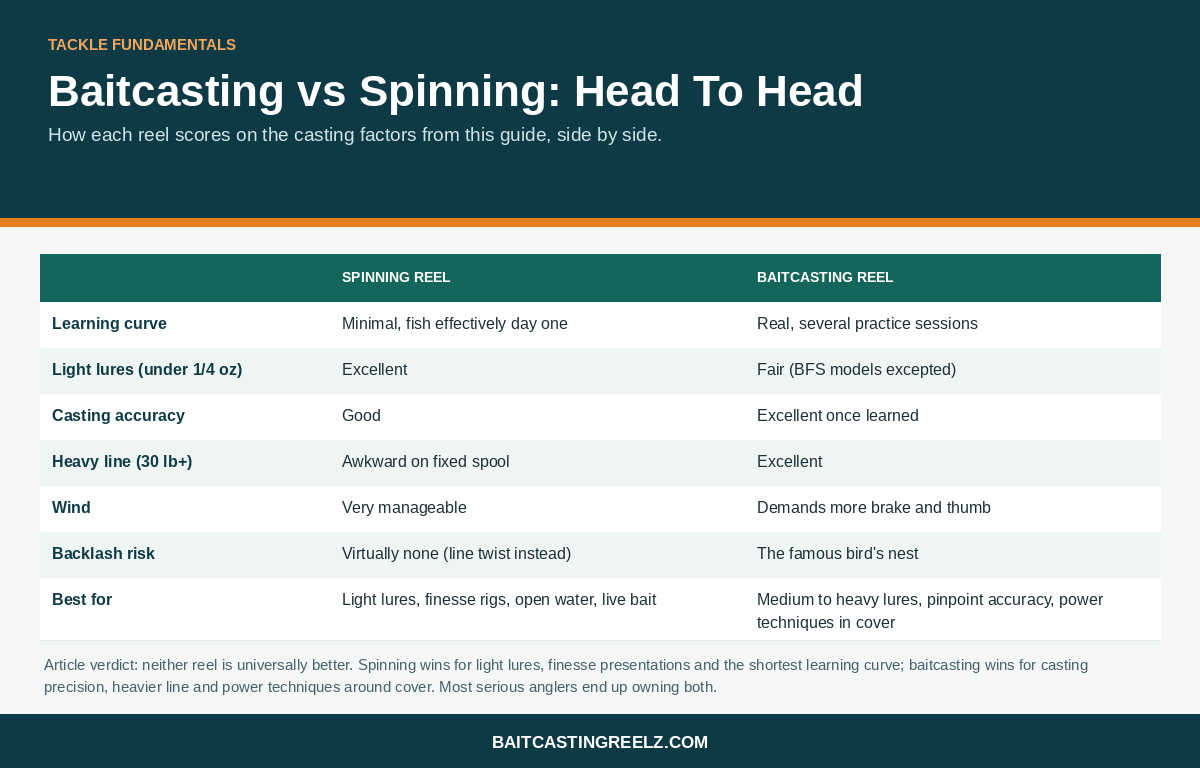
| Factor | Spinning reel | Baitcasting reel |
|---|---|---|
| Learning curve | Minimal, fish effectively day one | Real, several practice sessions |
| Light lures (under 1/4 oz) | Excellent | Fair (BFS models excepted) |
| Casting accuracy | Good | Excellent once learned |
| Heavy line (30 lb+) | Awkward on fixed spool | Excellent |
| Wind | Very manageable | Demands more brake and thumb |
| Backlash risk | Virtually none (line twist instead) | The famous bird’s nest |
Match the reel to the presentation
When a spinning reel makes more sense
Finesse presentations: drop-shot, Ned rig, shaky head, wacky worm; light lines (6–10 lb) and light weights are spinning’s home water. Trout and panfish: small spinners and light line demand the free-spooling cast. Skipping light baits under docks is easier to learn on spinning gear. Live bait and bobbers: simplicity wins. New anglers who want to fish effectively immediately should start here.
When a baitcasting reel makes more sense
Power bass techniques: flipping and pitching jigs, frogging matted grass, punching heavy cover, the baitcaster’s accuracy and winching power dominate. Moving baits: spinnerbaits, chatterbaits, crankbaits and swimbaits in the 3/8–1 oz range pair naturally with baitcasting gear ratios matched to the retrieve (see our setup guide for bass). Heavy line applications: 30–65 lb braid around cover behaves far better on a revolving spool. Big baits: swimbaits, musky bucktails and inshore lures suit round or large low-profile baitcasters.
Line and gear considerations for each reel
Line choice interacts with reel type. On spinning reels, use 6–12 lb monofilament or fluorocarbon for finesse, or 10–20 lb braid with a fluorocarbon leader for sensitivity without line twist headaches, braid’s lack of memory tames spinning reels’ biggest annoyance. On baitcasters, 12–17 lb mono is the learning line; fluorocarbon (12–20 lb) suits moving baits and jigs for sensitivity; 30–65 lb braid dominates heavy cover and frogging, where zero stretch drives hooks home. Gear ratio matters on both, but especially on baitcasters: 6–7:1 is the all-around choice, 5.x:1 for deep cranking power, 8–10:1 for techniques that demand fast line pickup like flipping and burning spinnerbaits. Check IPT (inches per turn) alongside ratio, it tells you the true retrieval speed.
Choose with this three-question test
1. What is the lure?
Under 1/4 oz most of the time: spinning. Mostly 3/8 oz and up: baitcasting starts earning its keep. This single question decides more setups than any other.
2. Where are you casting?
Open water and light cover: either works. Heavy cover, docks, matted vegetation, thick laydowns: the baitcaster’s accuracy and power pull ahead decisively.
3. What skill do you want to use today?
Want to fish now with zero practice? Spinning. Willing to invest a few sessions for a long-term edge in control? Baitcasting. Be honest, the wrong answer here is how reels end up gathering dust.
Optional: practice plug for baitcaster learning
If the answers point you toward baitcasting, a hook-free practice plug lets you build thumb control and brake feel in a yard before a fish is on the line, the fastest way to make the learning curve painless.
Why many anglers carry both
Walk any bass boat and you will see both reel types on the deck, typically a 7-foot medium-heavy baitcaster for jigs and moving baits alongside a 7-foot medium spinning rod for finesse. They are complements, not rivals: spinning covers light line and finesse, baitcasting covers power and precision. If your budget allows two combos, a medium spinning setup plus a medium-heavy baitcasting setup covers roughly 90% of freshwater lure fishing. If it allows one, let the three-question test above decide; and know that whichever you choose first, the other is a natural second purchase, not a correction.
Read next
Continue the comparison in depth: beginner tips, the parts breakdown, adjusting your reel, and our types of fishing reels overview. Ready to buy? Our Best Baitcasting Reels for Beginners and Best Baitcasting Reels Under $100 roundups match reels to skill level and budget.
Frequently asked questions
Is a baitcasting reel better than a spinning reel?
Neither is universally better. Baitcasting reels offer superior casting accuracy, better heavy-line handling and more winching power for cover techniques. Spinning reels offer easier casting, better light-lure performance and a near-zero learning curve. The right choice depends on lure weight, technique and how much practice you will invest.
Should beginners start with a baitcaster or spinning reel?
Start with a spinning reel if you want to fish effectively right away, especially with light lures. Start with a baitcaster if you are willing to practice and your fishing leans toward medium-heavy lures and cover techniques. Many anglers learn spinning first and add a baitcaster within their first year.
Can a baitcaster cast light lures?
Standard baitcasters struggle below about 1/4 oz, but BFS (bait finesse system) baitcasters with shallow, lightweight spools are designed exactly for light lures. For most anglers, though, light-lure work belongs on spinning gear.
Do experienced anglers use spinning reels?
Absolutely. Tournament pros keep spinning rods on deck for finesse presentations, drop-shots, Ned rigs, light shaky heads, where spinning gear is simply the better tool. Owning both is the norm, not a compromise.
Which reel type is better for bass fishing?
Bass fishing uses both heavily. Baitcasters dominate power techniques (flipping, pitching, frogging, cranking, swimbaits); spinning dominates finesse techniques (drop-shot, Ned rig, wacky rig). A serious bass angler eventually fishes both.
Is a baitcaster worth it for occasional anglers?
If you fish a few times a year with varied lures, a quality spinning combo gives more versatility per dollar and zero learning curve. A baitcaster becomes worth it when you fish often enough for its accuracy and power advantages to compound, or when a specific technique you love demands it.
Affiliate disclosure: baitcastingreelz.com participates in the Amazon Associates Program and may earn from qualifying purchases. The optional link is included for convenience. It does not affect our editorial guidance.