When to Replace Fishing Line on a Baitcaster: Mono, Fluoro, and Braid Timelines
Here is the short answer I give anyone who asks me at the ramp. Replace monofilament on a baitcaster at the start of every season. Replace fluorocarbon every season too, or every second season at the most if you fish lightly. Plan on two to four years from a spool of braid, and change it sooner if it turns fuzzy or badly frayed. Those three timelines cover most anglers, and everything else in this guide is about the exceptions, because fishing line rarely reads the calendar.
A spool of mono that baked on a hot boat deck all summer can be worn out in two months, while braid stored indoors can fish well past its third year. So I run my reels on two rules: a schedule based on line type and how often I fish, and a set of quick hands-on tests that tell me when a spool is done before the schedule says so. If you are still deciding between the three types, my braid vs fluorocarbon comparison is the place to start.
The Replacement Timelines, Line by Line
Monofilament: every season, no debate
Mono is a single strand of nylon, and nylon has two enemies: sunlight and memory. UV light breaks it down a little more every trip, and the longer it sits wound on a spool, the more it wants to stay in coils. On a baitcaster, tired mono also springs off the spool in coils during the cast, which means more overruns and shorter casts. Fresh mono is cheap and casts like a different reel, so I treat it as a seasonal consumable, like hooks. If you fish two or three times a week, do not wait for the season to turn: every four to six months is a better rhythm, and near-daily anglers often respool every month or two. When you do respool, the monofilament lines that hold up are the ones I trust not to coil up by mid-season.
Fluorocarbon: every season, two at the very most
Fluorocarbon handles sunlight better than mono and does not soak up water, so it ages a little more gracefully. It is also stiffer and pricier, and it hides its damage well. A nick in fluoro can be nearly invisible until the line pops on a hookset with almost no load on it. My rule is fresh fluoro every season on the reels I fish weekly. A reel that only comes out a few times a month, and lives in a rod locker between trips, can stretch to a second season, but no further. If you fish fluoro three or four days a week, treat it like mono and think in months, not seasons: every three to four months keeps you ahead of the nicks. Its condition also affects your choice of the right pound test to run in the first place.
Braid: measure it in years, judge it by wear
Braid is woven polyethylene, and it does not age the way nylon lines do. It has almost no memory, sunlight does not chew through it quickly, and a spool can fish well for two, three, even four years. The color will fool you: braid dye fades fast, sometimes within a few trips, and faded braid is not weak braid. What ends a spool of braid is physical wear: a fuzzy texture where the line runs through the guides, strands lifting and fraying, and rough patches you can feel after a season of dragging it over rock and timber. When the fuzz keeps coming back after you trim it, the spool is done. My picks in the my braided line roundup roundup are the braids that hold up longest under exactly this kind of use.
The Schedule I Actually Follow
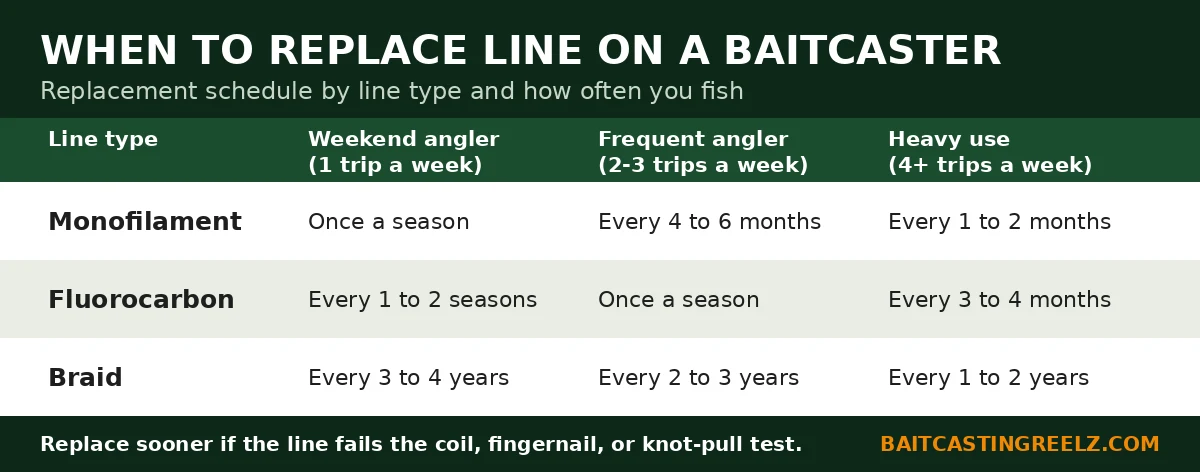
Calendars are easier to follow than gut feelings, so here is the whole guide on one table. Find your line type, find how often you honestly fish, and that is your respool rhythm. Every cell assumes the line passes the wear tests further down; a failed test means replace now, whatever the calendar says.
| Line type | Weekend angler (1 trip a week) | Frequent angler (2-3 trips a week) | Heavy use (4+ trips a week) |
|---|---|---|---|
| Monofilament | Once a season | Every 4 to 6 months | Every 1 to 2 months |
| Fluorocarbon | Every 1 to 2 seasons | Once a season | Every 3 to 4 months |
| Braid | Every 3 to 4 years | Every 2 to 3 years | Every 1 to 2 years |
Five Signs Your Line Is Done, Whatever the Calendar Says
1. Memory coils that jump off the spool
Pull a few feet of mono or fluoro off the reel and let it hang loose. Fresh line relaxes into soft, lazy waves. Old line springs into tight pigtail coils and refuses to straighten. On the water those coils are why your casts feel scratchy, your distance drops off, and your spool overruns more than it used to. If your reel suddenly seems harder to cast cleanly than it was in spring, work through the causes in my casting-distance problems guide, but put tired, coily line at the top of the suspect list.
2. Nicks, rough spots, and flat sections
Run ten or fifteen feet of line slowly through your fingers. Healthy line feels like one smooth strand. Worn line talks back: nicks, gritty patches, and flat spots where it has been crushed or dragged across rock, dock pilings, or a fish’s teeth. Any of those is a weak point, and line always breaks at its weakest point, usually with a good fish attached.
3. A stiff, chalky, or wiry feel
Mono that has dried out in the sun loses its stretch, and stretch is mono’s shock absorber. Old mono turns stiff and wiry, sometimes with a dull, chalky look, and it stops tying good knots because a hard strand will not cinch down evenly. Fluoro past its prime goes the same way: brittle, springy, and quick to snap at the knot.
4. Fuzzy braid and color that has washed right out
Faded braid alone is fine, since the dye gives up long before the fibers do. Fuzzy braid is not fine. When the section that runs through your guides starts to look fluffy, with fine strands lifting off the main weave, that line has been sanded down by a season of guide contact and cover. Trim a few feet and check further down the spool. If the fuzz runs deep, the spool has given you all it has.
5. Break-offs and knots you can no longer trust
One break-off is fishing. Two break-offs at the knot in one trip is a message. When knots start slipping, or the line pops on a firm pull well below what it should hold, the spool is suspect. Do not keep donating lures to the lake while you wait for a third opinion.
The 60-Second Three-Test Check
Before I strip any spool, I run three tests that take about a minute total. They are the difference between changing line on a schedule and changing it on evidence.
Test 1, the coil test. Pull off an arm’s length of line and lay it loosely on the deck or your palm. If it relaxes into gentle waves, it passes. If it snaps into tight coils and keeps them, the memory is shot and it is time.
Test 2, the fingernail test. Pinch the line lightly between your thumbnail and fingertip and draw ten to fifteen feet through, slowly. Your nail catches what your eyes miss: nicks, rough patches, and flat spots. Damage in the first few feet just means trim and retie. Damage that keeps showing up deeper in the spool means replace.
Test 3, the knot-and-pull test. Tie the knot you fish, hook it over something solid, and give it a firm, steady pull, the kind of pressure a hooked fish applies. Fresh line holds or breaks cleanly at honest strain. Tired line pops early, often right at the knot, with a sad little snap that tells you everything.
One more habit makes this easier: date your spools. When I respool, I write the month and year on a small piece of tape on the reel foot, so months later I am not guessing how old the line is.
What Shortens Line Life
Sunlight. UV is the number one killer of mono and fluoro. A reel that lives on the front deck between trips ages far faster than one that goes back in the locker.
Heat. A hot truck cab or a sealed boat compartment in July bakes line fast. Heat plus sun can take a season of life out of a spool of mono in a single month.
Abrasion. Rock, timber, dock posts, zebra mussels, and rough fish mouths all sand your line down a little at a time. The first thirty yards do almost all of the work and take almost all of the abuse, which is why they wear out first.
Backlash damage. Every bad overrun kinks mono and fluoro, and a hard kink never fully recovers. A reel that bird-nests often needs its line checked more often, especially where the worst tangles sat.
Saltwater. Line that is never rinsed after salt trips carries abrasive salt crystals into the guides cast after cast. A quick freshwater rinse after a salt day is cheap insurance.
Cut Back, Flip It, or Strip the Whole Spool?
Not every tired spool needs a full replacement. Here is how I decide.
Cut back when the damage lives in the top section only. Strip ten to twenty yards, retie, and fish on. Watch your spool level as the season goes on: a half-empty spool casts poorly, so check your fill against my guide on how full the spool should sit. When the level drops too far, topping up is no longer optional.
Flip it when the line is braid. Only the outer half of a spool of braid ever sees water. Wind it onto a spare spool or an empty reel, then wind it back, and the untouched half that was buried as backing becomes your working line. It can honestly double the life of a spool of braid.
Strip the whole spool when memory runs through all of it, when damage shows up deep, or when the knot test fails on a fresh section. At that point, follow a proper spooling routine like the one in my spooling guide guide so the new line goes on tight, even, and twist-free.
Make the New Line Last Longer
Store rigged reels indoors, in a cool, dark place, or at least in a closed rod locker. Never leave spare spools of mono or fluoro sitting in direct sun. Retie often, trimming a few feet before each trip, because the last few feet above your knot take the worst beating. Rinse line with fresh water after saltwater trips. And if nicks keep appearing in the same stretch of line, suspect a cracked rod guide insert and check it during your regular your regular cleaning routine, because no schedule survives a guide that is quietly sawing your line in half.
The Bottom Line
Line is the cheapest part of your setup and the only part that actually touches the fish. Run mono and fluoro on a season-based schedule, run braid for years and judge it by fuzz and fray, and let the three tests overrule the calendar whenever they disagree. Date your spools so you never have to guess. Fresh line casts farther, backlashes less, and holds the fish that old line was going to lose.
Frequently Asked Questions
How often should you change monofilament on a baitcaster?
At the start of every season for a weekend angler. If you fish two or three times a week, every four to six months is safer, and near-daily summer use can wear a spool out in one to two months. Change it sooner if it coils tightly, feels stiff, or fails the knot-and-pull test.
How long does fluorocarbon last on a baitcaster?
About one season of regular use. A lightly fished reel stored indoors out of the sun can stretch to two seasons at most. Fluoro hides nicks well, so run the fingernail test often and replace it the moment knots start breaking early.
How long does braided line last on a baitcaster?
Typically two to four years, and sometimes longer. Faded color is normal and harmless. Replace braid when the working section turns fuzzy or frayed, or flip the spool so the unused half becomes the working line and keep fishing it.
Does fishing line go bad if it sits unused?
Yes, slowly. Mono stored cool, dark, and dry can stay usable for a few years, but heat and sunlight age it even on the shelf. Before fishing any long-stored line, run the coil and knot-pull tests. If it snaps easily or feels brittle, replace it.
Can I just cut off the damaged part instead of replacing all the line?
Yes, if the damage is only in the top ten to twenty yards, which is where most wear happens. Trim back to clean line and retie. Once repeated trimming drops your spool level enough to hurt casting, or damage shows up deep in the spool, it is time for a full respool.
Does old line cause more backlashes?
It does with mono and fluoro. Old line holds the spool’s coils as memory, and those springy coils leave the spool unevenly during the cast, which invites overruns. If a reel that used to cast cleanly starts nesting more often, tired line is one of the first things to check.