Baitcaster Sizes Explained: What the Numbers Really Mean
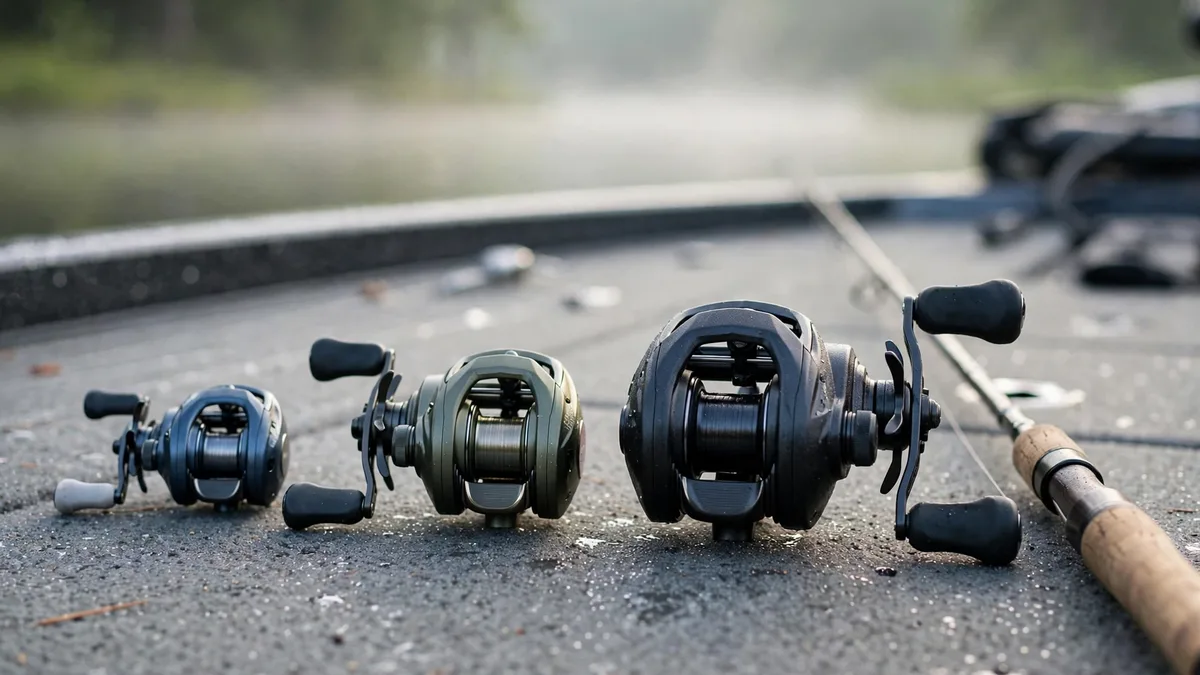
Baitcaster sizes run from 50 to 400 on low profile reels, and the number is a size class for the frame and spool. A small number means a small, light reel that holds less line. A big number means a larger frame, a deeper spool, more line capacity, and more pulling power. If you only remember one thing, remember this: the 100 and 150 sizes are the standard for bass fishing, and they handle most lures most anglers throw. Everything else on the scale is a step down toward finesse or a step up toward heavy work.
The confusion starts because no industry standard sits behind the number. Each brand assigns sizes to its own frames, so a 100 from one company can hold about as much line as a 150 from another. Brands also add extra digits and letters to the model name for the hand, the gear ratio, and the braking system, which makes a reel name look like a part number. Once you know how to read the whole name, and not just the size, the system takes about five minutes to learn. Here is the full breakdown, in plain terms.
The quick chart: every baitcaster size at a glance
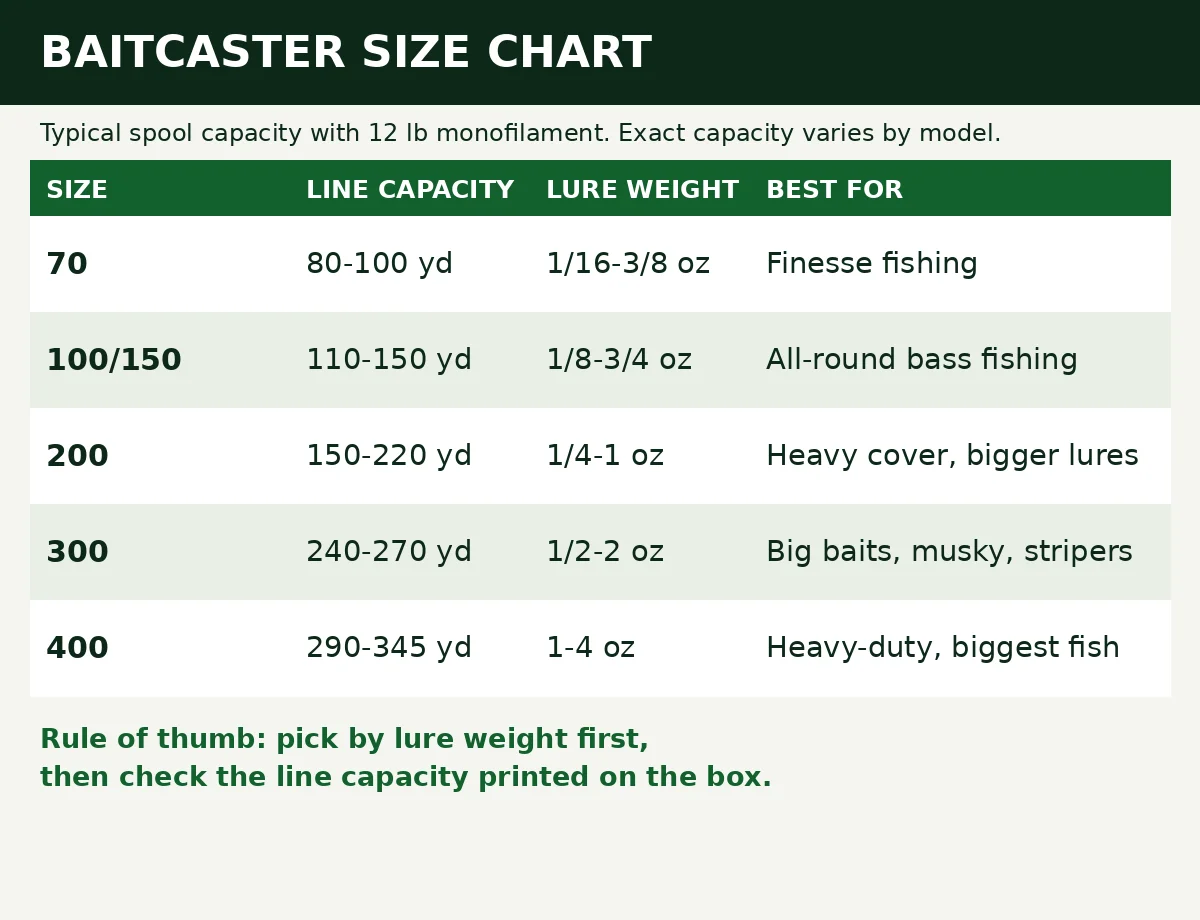
Start here. This chart covers the low profile sizes you will actually see in US tackle shops, with the lure weights and work each size is built for. Capacities are typical ranges for 12 lb monofilament, and the exact figure for any reel is printed on its box and spool.
| Size | Spool capacity (12 lb mono) | Lure weights | Best for | Target species |
|---|---|---|---|---|
| 70 | 80-100 yd | 1/16-3/8 oz | Finesse fishing | Bass, trout, panfish |
| 100/150 | 110-150 yd | 1/8-3/4 oz | All-round bass fishing | Largemouth, smallmouth, walleye |
| 200 | 150-220 yd | 1/4-1 oz | Heavy cover, bigger lures | Bass, pike, redfish, snook |
| 300 | 240-270 yd | 1/2-2 oz | Big baits, strong fish | Musky, striped bass, catfish |
| 400 | 290-345 yd | 1-4 oz | Heavy-duty casting work | Musky, big catfish, tarpon |
Two things stand out from the chart. First, the jump between sizes is mostly about line capacity and lure weight, not about quality. A 70 is not a worse reel than a 200, it is a smaller tool for lighter work. Second, braid changes the picture, because thin braided line packs far more yardage onto the same spool. Our guide on how much line a spool actually needs shows the spool math for each line type.
What the size number actually measures
The size number describes the physical size of the reel: the frame, and the spool that sits inside it. A bigger size class means a wider and deeper spool, a larger gear set, and a frame built to carry both. Line capacity is the practical result anglers care about, and it is the closest thing the number has to a real meaning.
What the number is not is a measurement. No governing body checks that one brand’s 200 matches another brand’s 200, and inside a single brand, two different 200 size reels can still differ in weight and capacity. Manufacturers design a reel for a job first, then assign it the size class it sits closest to. That is why the honest way to compare two reels is to compare the capacity printed on the spool, in yards of a stated line weight, instead of comparing the size labels. If you want to see the parts that change as sizes grow, our our reel parts guide walks through the frame, spool, gears, and drag stack piece by piece.
Each size in plain terms
70 size: the finesse reel
The 70 is the smallest size most brands sell, built for light lures and light line. The shallow spool starts up fast and casts baits in the 1/16 to 3/8 oz range that would stall a bigger reel, which is why finesse anglers and the BFS crowd love it. I use a 70 for small jigs, weightless soft plastics, and little hard baits on ponds and clear water. The honest limit is line: with roughly 80 to 100 yards of 12 lb mono on board, and even less room for heavy line, this is not the reel for pulling fish out of thick cover. Our roundup of the the smallest models and the the BFS reels covers the models that live in this class.
100 and 150 sizes: the standard bass reel
This is the size class the baitcaster world is built around. A 100 or 150 palms comfortably all day, holds enough 12 to 17 lb line for any bass technique, and casts the 1/8 to 3/4 oz lures that make up most bass fishing: jigs, Texas rigs, spinnerbaits, crankbaits, topwater plugs, and jerkbaits. If I could only own one baitcaster, it would be a 150, and it is the size I tell every beginner to start with. The models in our top-rated baitcasters guide sit almost entirely in this class, and for good reason.
200 size: the step up
A 200 keeps the same general shape but adds spool depth and cranking power. That extra capacity matters when you spool heavy fluorocarbon for flipping, throw bigger plugs, or fish inshore saltwater where a hooked fish takes line. It is also the size many anglers pick for big bass in heavy cover, where 20 lb line and a strong drag do the work. The trade is a little more weight in the hand, which most anglers stop noticing after a day on the water.
300 size: big baits and strong fish
The 300 class was built for swimbaits, musky lures, and saltwater casting. Spools hold 240 yards or more of 12 lb mono, drags are stronger, and the gears are cut for torque. Bass anglers who throw large glide baits and swimbaits live here, and so do musky and striped bass anglers. A 300 still casts and palms like a baitcaster, just a bigger one, and it asks for a heavier rod to balance it.
400 size: the top of the low profile range
The 400 is the largest low profile size, made for the heaviest casting work: big musky baits, large swimbaits, catfish rigs, and nearshore saltwater species like tarpon. Capacity runs toward 300 yards of 12 lb mono and the frames are built to take that strain daily. It is a specialist tool. For general bass fishing it is more reel than you need, and the weight will tire your wrist over a long day of casting.
How the big brands number their reels
Shimano uses 70, 150, 200, 300, and 400 across lines like Curado and Tranx. Watch the last digit of the size, because it tells you the retrieve hand: a 150 is right hand, and a 151 is the same reel in left hand. That one digit has caused more wrong orders than any other in fishing.
Daiwa uses 100, 150, 200, and 300, and its numbers sit one step lower on paper than Shimano’s. A Daiwa 100 holds about the same line as a Shimano 150, so a Tatula 100 and a Curado 150 are direct rivals even though the labels suggest otherwise. Daiwa puts the hand and speed in letters after the number instead: an H means a high gear ratio, and an L added to it (100HL, for example) means left hand.
Abu Garcia speaks two numbering languages. Its low profile Revo reels are sold mainly by series name, with capacities that land on the same 100, 200, and 300 scale as everyone else. Its famous round Ambassadeur reels use four digits instead: 4500, 5500, 6500, and 7000. On those reels the first digit is the spool width and capacity class, so a 6500 is a wider, deeper reel than a 5500. Some Abu models also drop a zero, which is why you will occasionally see a 300 class reel labeled as a 30.
Lew’s mostly skips the headline size number on its low profile reels and sells by series name instead. In practice, nearly all of its bass reels sit in the same capacity class as a 100 or 150 from Shimano and Daiwa. With Lew’s, ignore the name and read the capacity printed on the box, which is good advice for every brand on this page.
Read the whole model name, not just the size
Here is the part most size guides skip, and it is the part that saves you money. The size number is only the first piece of a reel’s name. The rest of the name tells you the retrieve hand, the gear ratio, and the braking system, and once you can read it, a model name stops looking like a part number.
Take a Shimano Curado 150 HG. Curado is the series, 150 is the size class, the 0 at the end means right hand retrieve (a 1 would mean left hand), and HG means high gear, a faster ratio for techniques like jigs and topwater. A Daiwa Tatula 100HL reads the same way: series, 100 size, high gear, left hand. Letters like DC on a Shimano flag its digital braking system, and SV on a Daiwa marks its versatile, forgiving spool design. Our guide to how gear ratios work explains what those ratio letters mean for the way a reel fishes. The rule is simple: the size tells you the body, and the rest of the name tells you the speed, the hand, and the brakes.
Round baitcaster sizes in 30 seconds
Round baitcasters, the classic barrel shaped reels, use their own scales. Abu Garcia’s Ambassadeur line runs 4500 to 7000, and many other round reels borrow the 1000 scale used on spinning reels. Round reels carry deeper spools and more line than low profile reels of similar weight, which keeps them popular for catfish, musky trolling, and salmon fishing. If that is your water, our guide to the the top round reels covers the main models. For most casting techniques, though, the low profile sizes in the chart above are the ones to learn.
How to pick your size
Work through three questions, in this order. First, what lure weights will you cast most? The size has to cast your everyday lures well, so match the size to the lure range in the chart. Second, how much line do you need? Long casts, heavy line, and strong fish all eat capacity, and heavy line fills a small spool fast. Third, what are you fishing for, and in what cover? Light line finesse work points down the scale, and heavy cover points up it.
Then match the reel to the rod. As a working rule, a 70 pairs with medium light rods, a 100 or 150 with medium to medium heavy rods, a 200 with medium heavy to heavy rods, and a 300 or 400 with heavy and swimbait rods. Mount the reel and hold the outfit at the foregrip: it should feel neutral, not tip heavy. Our step by step guide on picking the right baitcaster takes the decision further, through brakes, ratios, and budget. One last warning: do not mix these sizes up with spinning reel sizes, which run on a 1000 scale. Our guide to spinning reel sizes explains that system, and the two do not convert.
The bottom line
Baitcaster size is a class, not a measurement, and the class exists to match the reel to the lures, line, and fish you actually deal with. Pick by lure weight first, check the printed line capacity second, and read the whole model name before you buy. Do that, and the size that looked like a confusing number becomes the easiest spec on the box.
Frequently asked questions
What is the most common baitcaster size?
The 100 and 150 sizes are the most common. They hold enough line for general bass fishing, cast the lure weights most anglers use, and stay light enough to fish all day. Most best selling baitcasters are built in this class.
What do the numbers on a baitcaster mean?
The number is the reel’s size class, set by the size of its frame and spool. Bigger numbers mean a bigger spool, more line capacity, and a heavier, more powerful reel. It is not an industry standard, so the same number can mean slightly different capacities from brand to brand.
What size baitcaster is best for beginners?
A 100 or 150 size reel is the best starting point. It is forgiving to learn on, works with the widest range of lures, and will still be useful years later as a main reel. Very small and very large sizes are specialists that reward experience.
Is a 200 size baitcaster too big for bass?
No. A 200 is a fine bass reel, especially for heavy cover, bigger lures, and heavy line. It is slightly heavier than a 150 and holds more line than most bass techniques need, so it works best as a power outfit rather than an all day finesse reel.
Do all brands use the same size numbers?
No. Each brand assigns sizes to its own frames, so capacities overlap between neighboring sizes across brands. A Daiwa 100, for example, holds about as much line as a Shimano 150. Compare the printed line capacity when you shop across brands.
What size baitcaster do I need for musky?
A 300 or 400 size reel. Musky lures are heavy, the line is heavy, and the fish make long runs, so you need the spool capacity and drag these sizes carry. Most musky anglers pair them with a heavy or extra heavy rod built for big baits.